

By MICHAEL SCHREIBER
UPDATE IN JANUARY 2025 (A biography of William Spafford follows below.)
The restoration of the outside of this historic (ca. 1760) building appears to be complete! The ground story has been filled in with new brickwork. As reported earlier, the doorway has been relocated to the center of the building, allowing for a central hallway to be constructed behind it. This was a rather unusual feature in Philadelphia townhouses of the 18th century, which usually employed an interior hallway on the side of the building (in accord with plans that were common in London during that era).
Unfortunately, the new bricks protrude beyond the plane of the upper stories. They were laid to form an outer shell, which is separated from the inner wall by a gap of about five inches. In order to try to blend the new bricks with the old ones on the upper stories, the masons brought the shell all the way up to a protruding ridge under the second-floor windows.
Another unfortunate feature is that the new brick is slightly darker than the old brick of the upper stories. The effect looks especially odd on the Front Street side of the house, which is laid in a Flemish Bond style, with red bricks alternating with black half-bricks. Also, the historic rear section of the building was pulled down a few years ago; the second story of the replacement, instead of being faced with brick, is covered by a gray-colored surface (probably plastic composite). The effect is not displeasing, but it is not authentic.
In conclusion, even though the new brickwork does not quite match the old, this historic building as a whole looks many times better than what existed there for at least a century, when it was modified for commercial purposes and then allowed to steadily deteriorate. It is now very close in appearance to the architect’s drawing shown below.
(We will continue to follow and report on the restoration process as it progresses. Earlier articles about this building and its early occupants follow below.)
UPDATE IN OCTOBER 2024 — Exciting news! The restoration of this important 18th-century townhouse has restarted and is proceeding at a rapid rate. The cheap-looking brick wall that used to envelope the ground story of the structure (placed there during the 20th century when it served as a restaurant) has been removed. This allowed the inner course of bricks to be filled in and stabilized.
In the meantime, the old corner entrance to the building has been bricked up and replaced by a window. A historically accurate central doorway has been added in its place, complete with a columned door-surround.
Now, it appears that a new outer course of bricks, in Flemish-bond style, will soon be laid.
UPDATE IN OCTOBER 2023 — In mid-September 2021, the city posted a notice stating that this imposing house from the 1760s was “unsafe,” and threatening that it would be liable to be demolished in 30 days unless critical structural repairs were made. The current owner had been renovating the house as a single-family residence for close to five years, but the work remained at a standstill for some time. The rear two-story addition to the building, including a portion added in the 20th century, was demolished in early 2018 and then rebuilt with a shaft for an elevator. But the work remained incomplete, with an outer wall constructed in cinderblocks, without a top sheathing of bricks.
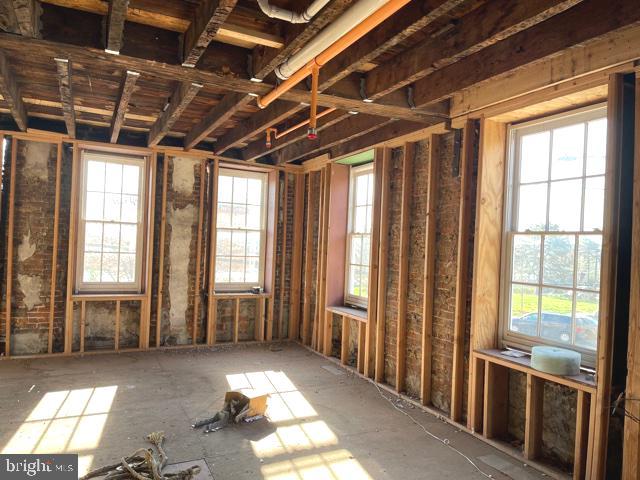
The main house was gutted of its interior walls, and some reframing took place, but the new walls were left unfinished. The floor of the basement, was lowered in order to gain more headroom, and a French drain was installed. Unfortunately, the most singular feature of the house, its central circular stairway, was stripped of what remained of its original bannisters. New window frames were inserted throughout the house, but the outer brick walls continued to deteriorate, with open gaps in the facade.
However, in July 2023, the building was sold to a new owner. Now, in October 2023, work has proceeded in fully restoring the building. Unfortunately, the reconstruction was halted by the city at the end of September for a lack of permits; hopefully, it will resume soon.

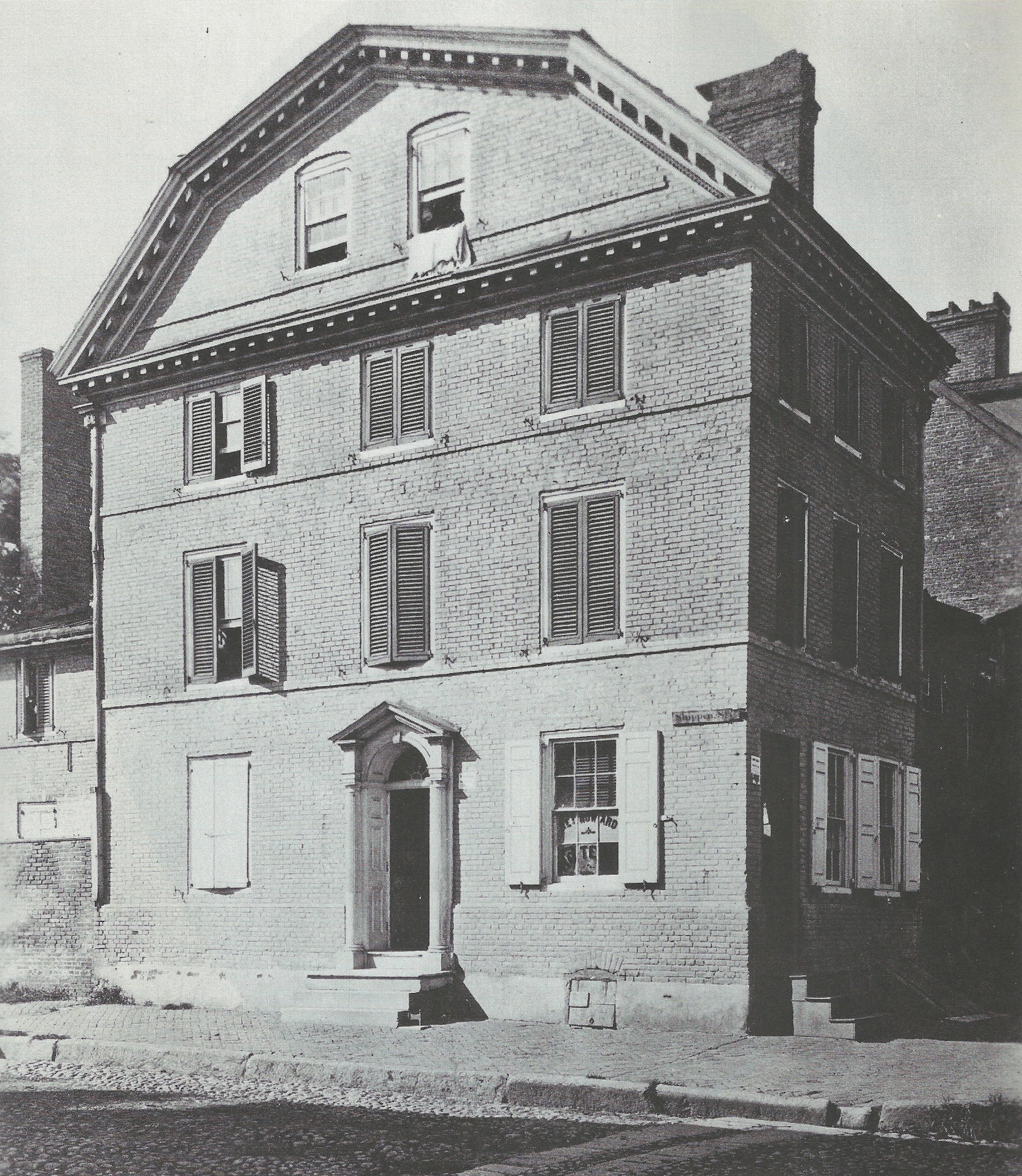
The nature of the ongoing construction work suggests that the new owners intend to restore the ground floor to an appearance resembling that of the original building, with a central entrance on Bainbridge St., and the windows replaced in their former positions (see above drawing of what the architects intend, which strongly resembles the photograph from the 1860s in the article below).
This building, home to two sea captains, is an important relic of mid-18th-century Philadelphia. Its restoration will be a wonderful victory for historic preservation. A brief story of its original occupants, first posted here in 2012, follows below.
*****
BIOGRAPHY OF CAPT. WILLIAM SPAFFORD AND HIS FRONT ST. HOUSE
The area around Front and Bainbridge Streets in Philadelphia (once part of the suburban Southwark district) once contained a number large and splendid 18th century townhouses. A row of these houses remains on the west side of Front Street. At one time, the house on the northwest corner was the luxurious residence of a sea captain, William Spafford (sometimes also spelled “Spofford”). A brief sketch of Capt. William Spafford’s life is below.
In the first years of the 19th century, the house was the home of another sea captain, Thomas Arnold, and his wife Catherine. Their eldest son, Dr. Thomas Arnold, also lived in the house and presumably conducted his medical practice from there until the summer of 1818, when both Catherine and young Dr. Arnold passed away. In later years, the house served as a tavern. A fuller biographical article on Capt. Thomas Arnold can be read on this website. See: https://philahistory.org/2022/08/31/the-master-navigator-capt-thomas-arnold/.
William Spafford was born in the last years of the 17th century and died in 1764. He married Rebecca Ellis at the First Presbyterian Church in 1719. Tragically, their son William Jr. died seven years later, and their son Thomas died in 1730.
Early in life, Spafford became a sea captain, ship owner, and merchant. Newspaper ads of the time show that in 1720 he was master of the sloop William, which he sailed to Antigua. During the next few years, he captained the sloop Sarah, which he owned, also in the West Indies trade. In 1726, he registered the 30-ton sloop Keith. William Spafford continued his sea voyages throughout the next decade, sailing the Three Bachellors to Barbados in the early 1730s, the Charming Sally to Ireland in 1736, and the brig Mary to Lisbon in 1738.
Capt. Spafford sold a variety of imported products at his store, which was located on the ground floor of his dwelling house at the corner of Front and Market. Slaves were included among his merchandise. For example, in August 1731 he advertised the sale of “a very likely Negroe woman … fit for housework or plantation work,” along with a cargo of good green tea. In 1734, he was selling a “young Negro man” and a “very likely Negro boy.” In July 1741, he had a “Negro Man” and “Negro Girl,” along with a lot of West India rum and Moscovado sugar. And in Sept. 1743 he advertised a “Negro Woman who can Wash, Iron, Scour, etc. and Cooks very well.”
Around that time, Spafford was making the transition from sea captain to the business of providing ropes and other equipment to ships. Capt. Spafford’s ropewalk was located on the west side of the Passyunk Road, near the corner of Oak Street (now Bainbridge); today, Spafford Street is nearby. He took on a young man, Timothy Scannel, as an assistant in the rope-making business. Scannel had just arrived in Philadelphia on a ship from Ireland, and was assigned as an indentured servant to “William Spafford, mariner.” Unfortunately, in July 1748, Scannel ran away. Spafford offered a reward for his capture and described Scannel as “of a thick short stature, full face, wears his own short black hair, very talkative, and speaks very fast … by trade a rope maker.”

Spafford advertised that he sold “ship chandlery, with cables and cordage of all kinds” at a store on Samuel Powell’s wharf. In December 1755, he moved his store to another wharf further south, which was “late of Messieures [Emmanuel?] Josiah and Carpenter.” The economic risks of the chandlery trade became clear in November 1760, when Spafford and other chandlers, a sailmaker, and a ship builder placed a notice in the newspapers asking for the apprehension of one John White. They reported that White had ordered a brigantine, called the Ranger, built, fitted out, and filled with cargo. Then, together with his wife, he sailed away to an unknown port, without paying any of the people who had built and provisioned the ship.
Although Spafford sold people into bondage, he apparently saw no conflict between that endeavor and helping to support the church. Thus, in 1753, he was listed as a manager of the lottery to raise money to build a steeple onto the Second Presbyterian Church in Arch Street. William’s brother George, also a sea captain and merchant, was another lottery manager. (Another sea captain, John Spafford, might have been another brother.) The completed steeple was almost has high as that of Christ Church, but George Spafford never got to see it. He died in 1754, leaving a portion of his estate to the church as well as to his widow, Sarah, and to his brother William.

At that time, William Spafford was still living at Front and Market Streets. In 1755, it was mentioned in a newspaper ad that William Spafford, now in his sixties, was living on Front Street in Society Hill. Ten years earlier, he had purchased a lot of ground “on the hill” at the corner of Front and Shippen (now Bainbridge) Streets. According to an insurance report, Spafford’s elegant townhouse was constructed there at least by by 1762—and probably as early as 1755. Spafford died in early 1764; his store on Water Street was taken over by his nephew, William Drewry.
Finally, a newspaper notice of June 2, 1768, indicated that the Passyunk Road rope-works property of William Spafford, deceased, was to be auctioned off by the sheriff. The property tax roles of 1769 list a Widow Spafford as living in Southwark, with one servant and one cow. It is unclear whether Rebecca Spafford still resided in the townhouse at Front and Shippen Streets, since one source indicates that she died in 1755, around the time that the house was built. In 1900, the ground floor was altered to accommodate a tavern.
The house — built with profits originally gained from the slave trade —once had a central hallway (unusual in Philadelphia), which led to a grand circular staircase. The ornate bannister was still intact at the second story level of the stairway, when I toured the building a number of years ago. Currently, however, the house lies empty and stripped of its finery.
 philahistory.org