

By AMY GRANT and MICHAEL SCHREIBER
Over 160 years ago, the Martin family lost their youngest daughter Lizzie to a mysterious and debilitating illness. Although her headstone still stands in the Gloria Dei churchyard, years of weathering have made the inscription difficult to decipher. But, if you look closely, the withered words will come into focus, revealing heartbreaking details about her final days. While other families were celebrating the 1857 holiday season, Lizzie’s family was mourning her death.
The epitaph on Lizzie’s stone reads as follows:

Memento of Lizzie
the affectionate daughter of
Thomas and Harriet Martin
Born March 16th 1837
Died Decembr 24 1857
When Christmas bells rang out their chimes
And holly boughs, and sprigs of thyme
Where hung on many a wall,
Our Lizzie in her beauty’s prime,
Lay in our darken’d hall.
No Yule log burned upon the hearth
We sang no song of Christmas mirth!
With hearts bow’d down—with spirit riven
We gave our darling’s soul to Heaven
Our gift to Christ the Lord.
Lizzie was only 20 years old at her death. She had probably caught the eye of many a young man, but remained unmarried at her death and was still living at home with her parents.
Lizzie’s parents, Thomas and Harriet Martin, were married in England and emigrated to Philadelphia when they were in their early thirties, together with their children. Lizzie was born soon afterward. Lizzie’s father was a house and sign painter by trade. Some years after arriving in Philadelphia, he began to buy and sell houses as a sideline, and soon became a real estate broker exclusively.1
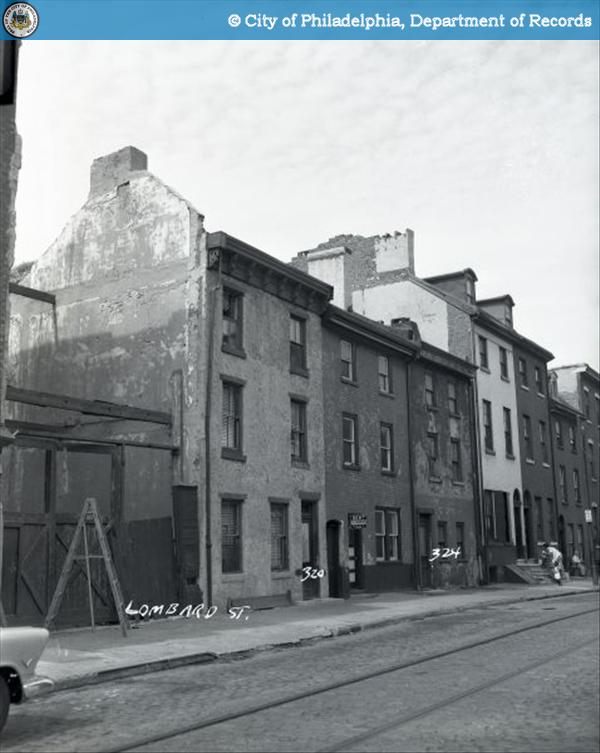
Apparently, the Martin family would often live in one of the houses that Thomas had recently purchased while he fixed it up for re-sale. Then, he would “flip” the building to a new owner, and the family would move on. For that reason, the Martins rarely lived at one address for very long—though they generally remained in the far southern districts of the city or in the adjacent suburb of Southwark.
Around a year before Lizzie’s death, the family moved into 318 Lombard Street (the site now contains a large modern house in the “colonial” style). The house was across the street from Thomas Martin’s real estate office on the northwest corner of Third and Lombard (currently a parking lot).
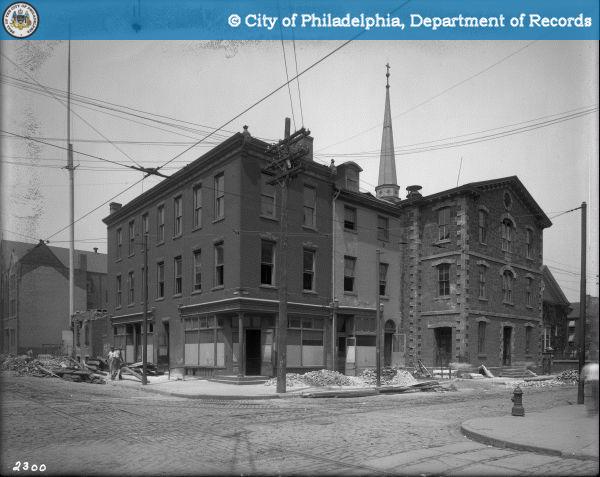
It was in the “darkened hall” of the Lombard Street home on a Saturday afternoon, Dec. 26, Boxing Day, that mourners paid their last respects to Lizzie before her body was carried to the Gloria Dei churchyard. She had died the day before Christmas at 4 in the morning, no doubt having suffered agonizing pain for some time.
Two years after Lizzie died, the disease that likely caused her demise was recognized as a unique ailment. English physician Samuel Wilks (1824-1911) determined that some patients diagnosed with dysentery were in fact suffering from “simple ulcerative colitis.”2 He discovered an “inflammation of the distal part of the ileum and the colon” during an autopsy of a woman “who died after a short illness of bloody diarrhea and abdominal pain.”3 Seventy-two years passed before this finding was confirmed by other scientists.
Despite intense study of ulcerative colitis in recent years, a cause has yet to be identified and there is “no known cure.” However, “treatment can greatly reduce signs and symptoms of the disease and even bring about long-term remission.”4
NOTES:
1 “On Saturday last Mr. Thomas Martin, a very well known citizen of the lower portion of the city died at his residence number 325 Lombard Street, in the 71st year of his age. Mr. Martin was the son of William Martin who published THE WILLIAM PITT NEWSPAPER in London many years ago. He came to this country about 40 years since and went into business at 3rd and Lombard as a painter. He afterwards adopted the business of real estate agent and collector and about 10 years ago removed to the northwest corner of 4th and Pine streets where he was successful in building up an extensive business. He retired upon a competency about 3 or 4 years ago.” — “Death of a Prominent Citizen,” The Public Ledger. Philadelphia, 8 June 1875.
2 Horgan E, Horgan J. “Chronic Ulcerative Colitis: Results of Treatment with Vaccine in Five Cases.” JAMA 93 (1929): 263– 266. Abstract
3 Dunea, George. “Sir Samuel Wilks (1824-1911).” Hektoen International: A Journal of Medical Humanities. Hektoen Institute of Medicine, 2007. Web. 25 February 2018. http://hekint.org/2017/04/19/sir-samuel-wilks-1824-1911/.
4 “Ulcerative Colitis.” Mayo Clinic. Mayo Foundation for Medical Education and Research, 2017. Web. 1 March 2018. https://www.mayoclinic.org/diseases-conditions/ulcerative-colitis/symptoms-causes/syc-20353326
 philahistory.org