
By MICHAEL SCHREIBER
In 2026, Founders’ Magazine, published by the Historic Gloria Dei (Old Swedes’) Church Preservation Corporation, intends to publish a series of articles on several people who took part in the American Revolution and are buried in Old Swedes’ churchyard. This is the first (incomplete) draft of an article to be included in that series; I intend to revise the article or expand it with more information at a later time.
George Ord, a patriotic sea captain during the American Revolution, was a parishioner of Gloria Dei (Old Swedes’) Church, where he is buried. Capt. Ord’s daring exploits on the seas are noteworthy, even though in the annals of history he was eclipsed by his son, George Ord Jr., who became a renowned zoologist and president of the Academy of Natural Sciences.
George Ord Sr. was born on May 26, 1741, in the seaside town of Whitby, at the mouth of the River Ask, in northern Yorkshire, England. After coming to America, he settled in the Philadelphia suburb of Southwark and close to the wharves on the Delaware River.
On Jan. 13, 1767, Ord married Rebecca Lindemeyer, the daughter of George (died 1765) and Judith (Justis) Lindemeyer. Rebecca, 24 years old, was the youngest of four sisters, and the last one to be married. Her sister Maria married the Rev. Eric Nordenlind of Gloria Dei (Old Swedes’) Church, in June 1759; unfortunately, her husband died a little more than a year later. Her sister Sarah married Capt. Joseph Blewer three months after Maria’s wedding, while Christiana married George Melin in June 1760. All of the marriages took place at Gloria Dei.
Around the time that George and Rebecca were married, a scandal took place at Gloria Dei Church, which must have shaken Rebecca’s family. Her sister Maria, now a widow, accused a former minister of the church— Dr. Wrangle—of having made unseemly sexual advances to her some years previously. According to a journal kept by the pastor who replaced him, the Rev. Anders Göransson, “Wrangle said [at an ecclesiastical meeting] that there was a woman who had something to testify against him. Whereupon [Pastor] Nordenlind’s widow was called in and she accused him of that which would seduce her to unchastity during the lifetime of her husband” (“Colonial Records of the Swedish Churches in Pennsylvania,” vol. 7A, p. 21).
However, George Ord might have been at sea when the scandal erupted. Merely two weeks after his marriage, on Jan. 29, 1767, he sailed to St. Kitts, in the West Indies, as master of the brig Greyhound. In the spring and early summer, Ord and the Greyhound undertook two more voyages between Philadelphia and the islands of St. Croix (a Danish colony at the time) and St. Kitts. Both islands were sites of large sugar plantations that were worked by African slaves. Later, Ord was assigned as captain of the brig Rose (sometimes described as the snow Rose), departing Philadelphia on Aug. 24 on a voyage to Jamaica. In November, he was back on the Greyhound on the run to St. Kitts, but in mid-December, he returned to the Rose for another voyage to Jamaica.
Also in 1768, George and Rebecca’s first child, Ann, was born. At the time, George Ord was a member of the vestry for Gloria Dei church.
Capt. Ord commanded the Rose for the next several years, often on voyages to Lisbon, Portugal. Soon after their return from Lisbon in September 1771, the Rose was put up for sale “with all her tackle, apparel, boats, etc., as she now lays at the late James Penrose’s wharf in Southwark.” The sale took place at the London Coffee House on Oct. 28, 1771.
In the meantime, Ord was assigned to command another vessel, the 55-ton brig Unity; they departed for St. Vincents on Sept. 19, 1771. St Vincents was another slave-plantation colony and a source of sugar, tobacco, coffee, and other crops. Throughout the 18th century, the British overlords fought many battles with the island’s Indigenous inhabitants (Caribs who had intermixed with Black Africans). After sailing on the Unity for two years, in September 1773, Ord began a series of voyages on the brig Grenada Packet, going to Barcelona via Quebec.
There are indications that George and Rebecca’s second daughter, Rebecca, was born in 1773, although some sources give 1775 or 1776 as her birth year.*
The Bermuda gunpowder raid
In the early spring of 1775, Ord commanded the 200-ton ship American, but on July 19 of that year, the Pennsylvania Packet newspaper reported that Ord had become master of the much smaller sloop Lady Catherine, with a 40-man crew. Earlier in the month, their destination was listed in the newspapers as Lisbon. But the departure was delayed, and the destination (as printed in the Philadelphia newspapers) was changed to St. Kitts. In secret, however, Ord had been directed to sail to a different location—Bermuda. Although the Lady Catherine was ostensibly proceeding on normal commercial voyage, in reality, the American revolutionary forces had engaged the sloop for a defiant raid on British military facilities.
Since April of that year, war had existed between Britain and her American colonies. The following month, the Second Continental Congress had begun to meet in Philadelphia, and on June 15, it appointed George Washington to head up a new Continental Army. By July, however, Washington’s army was in desperate need of gunpowder; only 36 barrels remained. Washington wrote to the president of Congress on Aug. 4 that his soldiers engaged in the siege of Boston had only enough powder to fire “not more than 9 cartridges a Man” (George Washington papers, Library of Congress). The only significant commercial powder mill in the colonies was the one in Frankford, a village just north of Philadelphia, but even its production had been cut back since sufficient supplies of saltpeter, sulfur, and charcoal were hard to obtain.
Then, a way to acquire more gunpowder suddenly appeared—although it would require daring and stealth. The enterprise took form in July 1775, when Col. Henry Tucker, a wealthy merchant from Bermuda who was sympathetic to the American cause, traveled as a delegate to Philadelphia for trade negotiations with members of the Continental Congress. The Bermudan delegation had come in response to the pending resolution of Congress to enact a trade embargo against colonies that remained loyal to the Crown. The embargo frightened Bermudans, who needed to import some 80 percent of the island’s food from abroad.
At first, the Bermudans offered salt in trade with the Americans in exchange for food. Although salt, for curing meat, was essential for the patriotic troops, Congress was cool to the terms of the offer. Then, Tucker explained to the delegates that Bermuda might be able to supply them with gunpowder from the Royal magazine on the island. He and Benjamin Franklin—one of the leaders of the Committee of Safety of the Province of Pennsylvania—huddled together and conceived a plan to seize the gunpowder; the plan was quickly approved by Congress and ordered to be put into operation. As part of the bargain, on July 15, 1775, Congress passed a resolution enabling the export of foodstuffs to British colonies in exchange for gunpowder, though Bermuda was not named specifically.
On the night of Aug. 14, 1775, Ord anchored the Lady Catherine beyond the rocks off the coast of Bermuda’s main island. Another vessel, the Charlestown and Savannah Packet, also helped in the operation. In the meantime, Tucker organized a band of men, who broke into the powder magazine and carried the kegs of powder to the shore, where they were rowed out to the sloop.
While the seizure of the powder was in operation, the governor of Bermuda, George James Bruere, was still asleep in his mansion—merely 200 yards away from the magazine. When he awoke at dawn, he spied the Lady Catherine’s sails on the horizon and immediately suspected what had happened. Reportedly, the governor was filled with rage. His anger against the Americans was no doubt fueled by the fact that his son—a British soldier—had been killed fighting the rebels in the Battle of Bunker Hill just two months earlier.
After inspecting the damage to the magazine, Bruere described in a letter how it was accomplished: “I had less suspicion than before, that such a daring and Violent attempt would be made on the Powder Magazine, which in the dead of night of the 14th of August was broke into on Top, just to let a man down, and the Doors most Audaciously and daringly forced open, at the great risk of their being blown up; they could not force the Powder Room Door, without getting into the inside on Top. They Stole and Carried off about one Hundred Barrels of Gun powder, and as they left about ten or twelve Barrels, it may be Supposed that those Barrels left, would not bare remooving [sic]. It must have taken a Considerable number of People; and we may Suppose some Negroes, to assist as well as White Persons of consequence” (Letter to Lord Dartmouth, Aug. 17, 1775, “Naval Documents of the American Revolution,” vol. 1, p. 1169).
Bruere reported in the letter that he had sent a cutter to chase the American sloop: “The next morning the 15th Instant [of August], one Sloop Called the Lady Catharine, belonging by Her Register to Virginia, George Ord Master, bound to Philadelphia, was seen under Sail, but the Custom House Boat could not over take Her” (ibid.).
In a subsequent letter, sent on Sept. 15, Bruere repeated the information about the raid and added that he had received intelligence that the Lady Catherine, along with the Charlestown and Savannah Packet, had been towed out to sea by “the Country Whale Boats,” which would account for how they were able to make such a quick getaway (“Naval Documents,” vol. 2, page 92).
It appears that the Bermudan robbers might have taken even more than the governor had realized at the time. The Captain of H.M.S Rose, James Wallace, wrote British Vice Admiral Samuel Graves on Sept. 9, 1775, advising him of the event. He recorded the entry of a vessel “from Bermuda belonging to Philadelphia which had broke open in the Night and taken out of the Magazine of that Island 126 barrels of gunpowder” (“Naval Documents,” vol. 2, p. 59). Each keg held 25 pounds of powder, for a total of 3150 pounds.
From Bermuda, the two American vessels sailed to Charlestown, S.C. They deposited a portion of the powder there for the use of Capt. John Cowper, who was stationed in North Carolina as Tucker’s agent. Ord then sailed the Lady Catherine to Philadelphia, arriving there on or before Aug. 26.
On Aug. 26, Col. John Dickinson, on behalf of the Continental Congress, asked the Pennsylvania Committee of Safety for information on the amount of gunpowder that they judged would be available to the troops. Their report stated that Capt. Ord had brought to Philadelphia some 1800 lbs. of usable powder from Bermuda, but that moisture had rendered 7 cwt. (1000 lbs.) of it unfit for use. (“Naval Documents,” vol. 2, page 166). The damaged powder was then sent to the new mill that George Lush had recently put into operation in Norrington (today Norristown, Pa.), which managed to salvage half of it.
The same day, Ord sent an invoice to the Committee of Safety on behalf of Col. Henry Tucker in Bermuda, charging them £161.14.8 for 1182 lbs. of gunpowder, and noting that eight half-bars of the powder had been given to Cowper in North Carolina. The minutes of the Committee of Safety for Sept. 2, 1775, indicated that committee member Robert Morris (also associated with the Willing and Morris shipping firm) was agreeable to paying George Ord and George Thomson at the rate of £15 per hundred lbs. for the powder they imported, plus an additional £4 per hundred as an encouraged for the importation of more gunpowder.
Ord had barely two weeks to spend in Philadelphia with his wife. On Sept. 11, he and the Lady Catherine were cleared for a voyage to Jamaica. That voyage also might have had a military purpose.
That same month, Congress created the Committee of Secret Correspondence (later the Committee on Foreign Affairs), comprised of four wealthy merchants—the Philadelphia partners Thomas Willing and Robert Morris, and New Yorkers John Alsop and Philip Livingston. They were enabled to draw on the Continental treasury in order to purchase from abroad a million rounds of gunpowder, 10,000 muskets, and 40 field pieces. Morris took the lead in using his worldwide contacts and the facilities of the Willing and Morris shipping enterprise to obtain the munitions.
And so, on Jan 16 of the following year, in a discussion on methods to procure gunpowder, the Continental Congress approved reimbursing Willing and Morris for $3233.20 “for the cargo shipped on board the sloop Lady Catherine for the use of the Continent” (“Journal of the Continental Congress,” “Naval Documents,” vol. 3, page 818). However, it is unclear whether Willing and Morris were being paid for the gunpowder seized in Bermuda the previous summer, or whether it was for a subsequent shipment on the Lady Catherine—perhaps from the Sept. 11 voyage to Jamaica.
Cruising the West Indies on the brig Retaliation
Toward the end of 1776, Capt. Ord was given command of the Retaliation, variously described as a brig or brigantine and armed with 14 six-pound cannon. Ord was engaged to work as a privateer in the West Indies.
American privateers during the Revolution were commissioned by Congress to seize enemy shipping by force of arms. After capturing British vessels, the American privateers generally manned them with small crews, and sailed them into a friendly port, where the cargo could be auctioned off for a profit. The captured vessel itself could be refitted with new colors—and sometimes a new name—and either sold or used in the revolutionary struggle. And cargoes that were considered to be of use to the Continental Army or Navy, such as weapons or gunpowder, were generally transported further to a port on the mainland—like Philadelphia or Charlestown, S.C.
Of course, the British referred to the American privateers as “pirates”—in other words, cutthroats and thieves. But according to international law, privateering crews were not to be punished by hanging, as pirates were. During the Revolution, it was common for the Royal Navy to send their prisoners into imprisonment on decommissioned ships, like the HMS Jersey in New York harbor, which were notorious for their lack of sanitation, scanty provisions, and epidemics of disease. Some seamen were given the option of joining the Royal Navy—which could also be an onerous fate.
Ord was employed at the time by Willing and Morris, which owned the Retaliation. Earlier in the war, Robert Morris, as a shipping merchant, had opposed privateering. By December 1776, having lost some of the company’s vessels to British privateers, Robert Morris vowed vengeance and resolved to invest in privateering himself. The shipping company’s agent in the West Indies, William Bingham, recommended a Martinique-based sea captain, Coctiny de Prejent, as a person with whom they could establish an expanded enterprise. Morris proposed that the three of them buy “a stout privateer”—the brigantine Retaliation—to cruise “amongst the outward bound West India men.” He said that he would use Willing’s and Morris’s company funds to furnish his stake in the project even though his partner, Thomas Willing, “objects positively” to privateering. He promised to repay the debt out of the vessel’s earnings should the cruise be successful, and “if not, I will repay them the amount here.”
William Bingham was stationed on the island of Martinique (generally called Martinico in English-language correspondence at the time). Although the French colonial authorities were ostensibly “neutral” in the conflict between the Americans and the British during this period, the governor displayed some sympathy for the American cause. Accordingly, Martinique and its harbor at St. Pierre provided a convenient port for American privateers in the West Indies to bring their prizes to be condemned and auctioned off, along with their cargoes.
Bingham, Morris, and Prejent were able to rake off enormous profits in the deals for the highjacked commodities. In particular, they derived profit from the sale of African slaves who had been captured from British vessels. Martinique had become a major slaving market, since the prices for slaves who had been seized from their “rightful owners” was much cheaper than at other locations.
Bingham also regularly commissioned vessels from Martinique that, although they had American privateering papers, contained foreign crews and even captains. In late 1777, a year after Bingham took up residency in Martinique, British spies wrote that 82 vessels were anchored in the harbor of St. Pierre and awaiting sale. “Every prize vessel proper to be converted to a privateer is fitted out as one. They all have commissions from Mr. Bingham.”
On Dec. 4, 1776, John Hancock, president of the Continental Congress signed Ord’s commission on the Retaliation—no doubt with Morris’s urging. The document read in part:
“To all unto whom these Presents shall come, send Greeting: KNOW YE,
“THAT we have granted, and by these Presents do grant Licence and Authority to George Ord Esq Mariner, Commander of the Briga called Retaliation of the Burthen of 90-Tons, or thereabouts, mounting fourteen Carriage Guns, and navigated by 100 Men, to fit out and set forth the said Briga in a warlike Manner, and by and with the said Brigantine and the crew thereof, by force of Arms, to attack, seize, and take the Ships and other Vessels belonging to the Inhabitants of Great-Britain, or any of them, with the Tackle, Apparel, Furniture and Ladings, on the High Seas, or between high-water and low-water Marks, an to bring the same to some convenient Ports in the said Colonies, in Order that the Courts, which are or shall be appointed to hear and determine Causes civil and maritime, may proceed in due Form to condemn the said Captures, if they be adjudged lawful Prize; …” (Printed in Transactions of the Connecticut Academy of Arts and Science [New Haven, Conn.: The Tuttle, Morehouse & Taylor Press] 1908, pp. 63-64.)
Around the beginning of the new year, Ord arrived in Martinique, where Bingham and Prejent had arranged for the Retaliation to be waiting for him to take command. They soon gathered a crew of about 25 men.
The Retaliation proved to be extremely successful in her privateering activities—and highly profitable for her owners. She brought in 13 prizes on her first cruise. From Philadelphia, the highly pleased Morris wrote to Bingham: “I dare say Captain Ord and you have done something clever together by this time” (cited in Robert C. Alberts, “The Golden Voyage: The Life and Times of William Bingham, 1752-1804”).
On March 18, 1777, in the vicinity of St. Vincent, the brig came across the Venus, a British “Guineaman” that was carrying African slaves across the Atlantic and into bondage on the island of Grenada. A report of the three-hour battle was contained in a letter from an English slave merchant in Martinique who was writing to one of the owners of the Venus. An extract from the letter, reprinted in the British publication “The Renzembrancer; or An Impartial Repository of Public Events, for the Year 1777,” pp. 142-43 (also reprinted in “Naval Documents‚” vol. 8, part I, pp. 176-177), appears below:
“The French enjoy all the advantages of a war, without any of the inconveniences; prizes are brought in here every day by privateers, who call themselves Americans, but are in reality French property, manned by French, Spaniards, etc. Guineamen are their principal objects, which they frequently fall in with. Above a dozen have been already brought in here and sold, with their cargoes, from ten to twelve Joes a head. I have been here this week past, endeavouring to recover a sloop of mine, with fifty-four new Negroes, taken by a sloop belonging to this island, under American colours; she had French papers, and notwithstanding I have proved her to be French property, the General absolutely refused to give her up, merely because he supposed her having cleared out at Grenada for Tobago; such injustice never was heard of; for suppose her English property, and the sloop an American, this is a neutral port, and can afford no Court of Admiralty for the condemnation of their prizes; in short, nothing but a war can stop their iniquitous proceedings.
The letter continued: “Your brig, the Venus, Capt. Sharp, was taken the 18th inst. close in with St. Vincent, on her way to Grenada, by a sloop belonging to Mr. Pregent, of this island, but under American colours, named the Retaliation, Capt. [George] Ord, (the only American on board her.)”
The allegation that the Retaliation and other privateers under American colors had non-American crews was probably true. It was echoed by other reports, including one by John Dobson, the president of the Chamber of Commerce in Liverpool, who sent a letter in May 1777 to his colleagues in Bristol. Dobson claimed that according to “intelligence” received from various people in the West Indies, the Retaliation was “manned with French, Portuguese, and Spaniards, having only an American [Ord] for master” (“The Renzembrancer,” p. 143).
The slave merchant at Martinique continued his letter with a description of the battle between the Venus and the Retaliation: “The Venus made a noble defence, and had it not been for boarding, would not have surrendered; she fought the sloop three hours, and even when boarded, would not strike. Mr. Wilson, the supercargo, was shot through the body by a pistol, of which wound it is thought he will die; three others were terribly wounded with cutlasses. I have done all in my power to serve them, and made Mr. Pregent promise, that when they can be removed, they shall be sent to some of the English islands.
“The Venus is lying in a bay about a league from hence; I should claim her as English property, did I think it would avail any thing, but I know it would not. The Governor, on my too peremptorily demanding the sloop and Negroes to be restored, told me, that had I not brought him a letter from Lord McCartney, (our Governor at Grenada) he would lodge me twenty-four hours in the common gaol for my temerity.”
It seems fairly certain that the slaves that Ord and the Retaliation had captured were not restored to their British “owners,” and were instead—as was the usual practice—put up for sale in Martinique. As a matter of course, Capt. Ord would have shared in the profits. Ord presumably had no moral reservations against involvement in the slave trade. At the time, he owned a Black house slave in Philadelphia, and his brother-in-law and close friend, Capt. Joseph Blewer (see the article about him on this website), had worked as a slave trader before the Revolution.
A few weeks after the encounter with the Venus, Ord and the Retaliation teamed up with several other privateers in an action against a fleet of British vessels, including slavers. A letter from St. Eustatia, dated April 5, 1777, states, “The privateer Rattlesnake, Captain McCullough, in company with Capt. Ord and others, have taken and sent into that place [St. Eustatia] two ships from Cork; and six or seven from the same port into Martinico; also some ships from Africa with slaves” (Providence Gazette & Country Journal, May 10, 1777). Evidently, some 498 slaves were being carried on those vessels, along with a cargo of African ivory; the profits accorded to Bingham, Morris, and the other partners was immense.
When word got back to Robert Morris about the latest success, he dashed off a letter to Bingham (April 25, 1777): “I have lately had the pleasure to hear that Ord in company with the Rattlesnake had taken and sent into Martinico nine sail of transport ships [and] two Guinea men [slavers] and two sail of transports into St. Eustatia. If this be true, and it seems well authenticated, we shall make a fine hand of it.”
The relish with which Robert Morris and his “patriotic” partners counted their profits on the backs of enslaved Africans seems especially hypocritical when it is acknowledged that thousands of former slaves fought on the American side in the Revolution. For example, according to Trinidadian historian CLR James, in his essay “Revolution and the Negro,” “Of the 1900 French troops who recaptured Savannah, 900 were [Black] volunteers from the French colony of San Domingo [Haiti].”
Ord and the Retaliation continued their successful cruises throughout the year; in early December 1777 the Retaliation defeated the 16-gun British privateer Lord Howe, probably close to the island of St. Vincent, and carried her into Martinique (reported in the North Carolina Gazette, Jan. 9, 1778).
A deposition by Josiah Durham taken on Dec. 13, 1777, reported that the Retaliation was sitting in the harbor of St. Pierre, Martinique, with her prize, the Lord Howe, along with many other American privateers. Durham said that he observed “many English Sailors in chains on board the Philadelphia Brig and on his asking why they were so treated, was answered that the Captains of the Privateers had orders so to do, and to carry, or send all those they should take to America.” He also reported that preparations were being made in Martinique for a war that many expected to be coming with the English. He commented that “the sober part of the inhabitants seemed to dread it [the war] much & the Americans to wish it” (“Naval Documents,” vol. 8, pp. 732-733).
A letter from January of the next year by another “gentleman” in Martinique again lists the Retaliation with seven other privateers as being owned and fitted out by people on the island, but sailing under the colors of the Continental Congress, He expresses confidence that “France will not let us fall” (Maryland Journal, and the Baltimore Advertiser, March 10, 1778).
Ord is mentioned in a May 19, 1778, letter by John Maxwell Nesbit—a major Philadelphia merchant and Pennsylvania Council of Safety member—to his brother, merchant and fellow patriot Alexander Nesbit at Metompkin Inlet, on Virginia’s Eastern Shore. At the time, Ord was also at Metompkin and was about to sail for Martinico. Nesbitt suggested that his brother entrust various items of correspondence to Ord to carry to Martinico. Nesbit also noted that British troops, who had been occupying Philadelphia, appeared to be pulling their heavy artillery out of the city (they withdrew all of their troops on June 18). (“Naval Documents,” vol. 12, pp. 393-394.)
But the British were far from defeated. In the meantime, the Royal Navy had been reinforcing its fleet. Lord Howe now commanded 71 vessels, including at least 17 heavily armed ships and frigates (36 to 64 guns), off the Atlantic coast of America—with still more assigned to the West Indies and the Caribbean. When facing such heavy firepower, the American privateers often found themselves as the prey of the British, rather than the hunters. Nevertheless, despite the dangers, the number of American privateering vessels continued to increase.
It appears likely that in August 1778, Ord was captured by the British privateer General Matthews—although records of the occurrence remain obscure. A day or two later, the General Matthews captured the New England merchant sloop Polly, under Capt. Samuel Perkins, which had been sailing from Boston to Virginia with a cargo of salt in company with the Brune. The next day, Ord was given his freedom and given command of the Polly, which he conveyed safely to Lewes Town, Del. It is not clear whether Ord’s release involved a prisoner exchange or any other concessions.
The Polly remained moored in Lewes Creek for over a year. In March 1779, she was advertised for sale by Major Henry Fisher: “Burthen about forty-five tons, built in New England (never having been to the West Indies) with all her tackle and apparel; main-sail new, fore-sale, square-sail, and jib very good” (Pennsylvania Journal, March 10, 1779).
In Philadelphia: The Ord & Inglis privateering fleet
It is not clear whether Capt. Ord made any more sea voyages after being taken prisoner and bringing the Polly to safety. Having returned to Philadelphia in 1779, Ord was appointed to a committee assigned to investigate the skyrocketing prices of many commodities in the city and suburbs. The report to the May 27 town meeting that authorized the committee noted: “The prices of rum, sugar, flour, coffee and tea have greatly arisen within this week past, without any real or apparent cause.” It added that “it is our determination not to be eaten up by monopolizers and forestallers.”
The committee was given the task of comparing the prices of the named goods in May to where they had stood January. They were also given the power to inspect cargoes upon arrival on the docks. They then were to set about in regulating and reducing the prices, and to report back to a later town meeting.
In August 1779, Ord joined in partnership with Robert Morris and William Bingham while registering the brig Retaliation. It is unclear whether the vessel was in fact the old Retaliation or a new one with the same name. The older vessel had 14 guns while the Retaliation of 1779 had only eight. Philipps Kollock—probably the son of Capt. Cornelius Kollock, who had a notorious record in the slave trade some 40 years earlier—was named as the master. Kollock and the brig Retaliation were sent on a voyage to France, together with other armed American vessels—arriving in Nantes in early December 1779 (Pennsylvania Packet, Feb. 24, 1780).
Also in 1779, Ord partnered with Samuel Inglis in financing, fitting out, or insuring at least eight privateers. The partners owned several of the vessels, while others were owned by Willing and Morris, Jeremiah Fisher, and other merchants. Inglis, who had been born in Philadelphia to John Inglis and Catherine McCall, had been the Willing and Morris agent in Norfolk, Va., and specialized in trade to the West Indies. He moved to Philadelphia after the start of the Revolution, probably around the time that his father died (1775), and became a full partner in Willing and Morris and Co.
Now that George Ord was firmly rooted in Philadelphia, he and Rebecca set about to build a home and family. In late 1779, their third daughter, Maria, was born—19 years after their first daughter, Ann. But even after baby Maria’s birth, Rebecca, along with her sister, Maria Blewer, were noted as being among the women of their neighborhood who helped to raise money to aid the revolutionary troops.
In this period, George Ord once again became active as a member of Gloria Dei Church. During the late 1770s, the church had been riven by disparate views on the revolutionary struggle. The Rev. Göransson leaned toward the side of the British, and a number of parishioners who were fed up with their pastor’s Tory sympathies left the church. Now in 1780, with a new minister, Matthias Hultgren, in the pulpit, it is likely that many returned to the congregation. The British had destroyed all of the pews when they converted the church building into a military hospital during their occupation of the city, and the bell had been removed from the tower. A lot of clean-up and repair had to be done. Under these circumstances, on May 1, 1780, George Ord was nominated as a member of the church vestry. He was duly elected to the position—and reelected annually for at least the next eight years.
Meanwhile, Ord & Inglis encountered overall success in their new business of providing vessels for privateering. Nevertheless, several of their vessels were lost in armed action or due to storms at sea.
In 1780, Ord & Inglis registered the privateer brig Ariel, with 16 guns and a crew of 100, under master Peter Lawler. While cruising for prey off the Carolina coast, the Ariel took the ship Susanna; the prize vessel had been voyaging from Cork to Charlestown [Charleston], S.C., with a valuable cargo of provisions for the British occupying forces. In November, the Ariel captured a sloop carrying a load of salt from New York to Charlestown, S.C.. And at the end of the year, near Charlestown, she took the galley Cornwallis, the brig Chance (with a valuable cargo from Lisbon), and a schooner from Halifax. Soon afterwards, the Ariel was chased by two frigates but managed to outrun them. She then encountered four British ships, two of which appeared to be large men of war. After Capt. Lawler ordered the stern guns to begin firing, the ships decided to back off.
In the meantime, Lawler had sent the Chance with a prize crew up to Philadelphia, where her cargo of 150 pipes of wine, 90 boxes of lemons, raisons, figs, etc., was put up for sale at Willing’s and Morris’s Wharf (Pennsylvania Packet, Feb. 10, 1781). Two months later, material from the Cornwallis—including ammunition, gunpowder, bayonets, pistols, and sabres—was sold at the same venue (Pennsylvania Packet, April 10, 1781).
The Ariel (which is probably the same vessel, though with 14 guns) was registered again in 1781, with Peter Miller as the captain. In May 1781, Miller and the Ariel were able to obtain what seemed like an important victory when they (re)captured the armed merchant ship Resolution, Capt. Waterburg. In April, the Resolution had been bound from Dominica to Amsterdam when she was captured by the Hetty and the ship Earl Cornwallis, out of Charlestown, S.C.. She was then retaken by the Baltimore privateers Antelope and Felicity, but captured again by the Revenge of London before the Ariel finally snatched her and sent her to Philadelphia.
The case against the Resolution was then brought to Admiralty Court. The grounds of the captors (Capt. Miller and others) was that a British crew had held the ship for at least 24 hours before the Ariel took her; therefore, she was a British ship and the owners and seamen of the Ariel were entitled to claim her, according to the international rights of war. Their opponents argued, however, that the ship was not originally British but Dutch property, and that the cargo was not originally British because it originated on the island of Dominica, which had been seized by Britain by force of arms. The judges effected a compromise—the captors could keep (and sell) the cargo, but the ship Resolution should be acquitted.
The decision was appealed, and the case went to the U.S. Supreme Court. Within the lengthy text of their ruling (Miller et al v. The Ship Resolution), the justices pointed out that the Continental Congress had passed an ordinance stating that “you shall not seize or capture effects belonging to the belligerent powers [i.e., Britain] on board of neutral vessels.” Therefore, they reversed the decision of the Admiralty Court and ruled that the cargo, like the ship, were exempt from seizure (see https://chanrobles.com/usa/us_supremecourt/2/1/case.php).
The Resolution had been carrying 350 hogsheads of sugar and a large quantity of coffee, cotton, and other products. These commodities were sold in July at Bright’s Wharf (Pennsylvania Packet, July 12, 1781). In line with the Supreme Court’s ruling, one would assume that the owners of the Ariel, George Ord and Samuel Inglis, received nothing from the proceeds of the sale. Yet the legal ramifications of the dispute were more complex. Early in the next year, federal marshal Clement Biddle advertised that he was holding £265, 15 shillings, and five pence, which was to be distributed to Capt. Miller and the Ariel’s crew as their share of profits from the sale of the cargo (Pennsylvania Packet, Feb. 28, 1782).
While the situation with the Ariel was tied up in the courts, Ord and Inglis had other vessels in the game. A year earlier, on Feb. 20, 1781, Ord & Inglis registered their ship Delaware, with eight guns, a crew of 30, and John Prole as master. The Delaware went into action in the Atlantic; in March, she captured the brig Hope, which was carrying 6000 bushels of oats from Plymouth and Charlestown, Mass., to New York (Connecticut Courant, April 3, 1781. The prize vessel and her cargo were brought to Philadelphia for sale. After a voyage to Grenada, in which she managed to dodge the expected attack on the island by the Royal Navy, the Delaware was sent to France. She arrived in Nantes in mid-August; within her cargo were newspapers and books for Benjamin Franklin, which his nephew had sent to him.
Unfortunately, the Delaware encountered trouble on her return voyage and was wrecked. A lot of damaged dry goods that were saved from the ship—including Britannia and Pontivy linens, serges, naps, swankins, calamancoes, and broad cloths—were put up for auction in Philadelphia (Pennsylvania Journal and the Weekly Advertiser, Dec. 19, 1781). The following May 1, more materials from the ship—such as her cannon, her anchor, and a lot of “half-worn rigging”—were auctioned off in Lewes-Town, Del., by Capt. Prole (Pennsylvania Packet, April 23, 1782).
On June 4, 1781, Ord & Inglis registered the armed boats Dreadnought—captained by Henry Darnell [Darnol?] and the Hooker, captained by Henry Martin—each with two guns and designed to cruise the Delaware River. As it turned out, within several weeks, the Dreadnaught and the Hooker found themselves pursued by the British privateer schooner General Arnold. In attempting to escape, they were captured “near the fishing banks” by the British armed barges Trimmer and Andre. The boats were conveyed to New York City by their captors, where they arrived on July 1 (The Newport Mercury, July 7, 1781).
In the meantime, on June 18, 1781, Ord & Inglis registered their four-gun brigantine Virginia, and on June 20, they registered the cutter Maestrand, with 10 guns and a crew of 20.
The Ord & Blewer chandlery: A new home
Also in that period, George Ord set up business as a ship chandler (a business selling ropes, sails, tackle, paint, pitch, tools, and other supplies). He partnered with his brother-in-law, Joseph Blewer, in the enterprise, and they established a warehouse between S. Water and Penn Streets, next to the docks. Soon afterward, in 1781, George and Rebecca’s son, George Jr., was born. Their daughter Henrietta was born two years later, on Oct. 16, 1783 (she died in 1843). In that year, Ord’s partnership with Samuel Inglis came to an end due to Inglis’s sudden death at age 37.

Around that time, the Ords purchased a spacious 3 1/2-story house at 354 S. Front Street (after renumbering in 1857, it became 784 S. Front), with a garden to one side and several back buildings behind it.**
In 1785, Ord was appointed warden of the port of Philadelphia. Although Ord was elected to the Gloria Dei vestry throughout the 1780s, perhaps his loyalties appeared to be flagging. In late 1786, the Rev. Matthias Hultgren wrote in his diary about a number of the vestry members; the remarks were very critical. He noted: “George Ord, 48 years old, born in England, [Sea] Captain, Church Councillor, married with Swedish wife, but keeps to the English Church. His children are baptized by Swedish Pastors.” Ord’s brother-in-law, Joseph Blewer and his family, received similar criticisms: “These come quite often to the Swedish [Church], but keep mainly to the English Church.”
Two years later, however, charges of misconduct flared against the Rev. Hultgren, of which Ord and Blewer, as members of the church council, were very well aware.
Another daughter, Elizabeth, was born to the Ords on March 3, 1788, but she appears to have died in infancy. In 1789, Joseph Blewer died—obviously a great blow to the entire family. His widow, Sarah, responded by selling a “negro girl” that had been part of her husband’s estate. The ad in the Pennsylvania Packet and Daily Advertiser (Nov. 17, 1789) noted that the girl had about 13 years yet to serve, as part of the state’s gradual emancipation law.
After Blewer’s death, Ord continued to run their rope and chandlery business on his own, though by 1800, 19-year-old George Ord Jr. had begun steady work in his father’s business. The 1801 Philadelphia street directory locates the warehouse of Ord, chandler & rope maker, south of the Pine St. Wharf (#99 South Wharves). The establishment was located next to the loft of James Forten, a sailmaker and a major voice of the free Black community. Among the products that Ord marketed at this time, along with other chandlers, was a device called Gould’s Patent Nautical Perambulator, “which shows the exact distance of a ship’s run in the cabin, the whole of which weighs only 3 1/2 pounds” (ad in The Philadelphia Gazette & Daily Advertiser, Jan. 1, 1802). Ord also served as a manager of the Society for the Relief of Poor and Distressed Masters of Vessels, their Widows and Children during this period.
In the meantime, there were developments with George Ord’s family. In 1797, the Ords’ daughter Rebecca married Joseph Karrick, a merchant based in Baltimore and Philadelphia, who soon established important trade ties in the Caribbean and Europe but was associated with some risky financial endeavors.***
In 1803, Maria Ord, 23, married the silversmith John McMullin, 14 years her senior. The marriage, on Jan. 27, took place at the Third Presbyterian Church on Pine St. The following year, in Baltimore, her brother George Ord Jr. married Margaret Biays, the daughter of Col. Joseph Biays, a Baltimore rope maker and ship builder, and the former Margaret McMullin, who was John McMullin’s older sister. John McMullin’s youngest son later married Maria Ann Pinkerton, the daughter of Ann Ord and Daniel Pinkerton.
On Jan. 7, 1805, the Karricks’ little daughter Rebecca, almost three years old, died. However, barely a month after the toddler had been buried, on Feb. 13, 1805, a new baby girl was born to Rebecca Karrick, to whom the parents also gave the name Rebecca (the child lived until 1898).
On Oct. 13, 1806, Capt. George Ord died. He was 65. Paulson’s Daily Advertiser mourned him as an “old and respected inhabitant of Philadelphia.” In his will, drafted a month earlier, Ord left most of his property to his widow and his children, Ann Pinkerton, Maria McMullen, Henrietta Ord, and George Ord Jr. The portion given to Rebecca Karrick was given in trust, with George Jr. as the trustee. George Jr. was also designated as co-administrator of the will, along with his widow Rebecca.
After Ord’s death, his widow Rebecca, and George Ord Jr. and his family, continued to live in the house at 354 S. Front St. Sadly, in 1808, Margaret Ord, George Jr.’s wife, died—merely four years after their marriage—but she left him two children.
Rebecca and George Jr. continued to operate the chandlery; Capt. Ord’s will had requested that they do so for at least eight more years. In fact, George Jr. continued to oversee operations in the shop until 1829. George Ord & Co. also attempted to carry out some merchant activities, as illustrated by the following note to Capt. Patrick Hayes from March 17, 1810: “Enclosed you have an Invoice of some small articles, which we have shipped on board the Sch. Sally, whereof you are master, bound to Havanna, and which we have consigned to you, to be sold to the best advantage. If you cannot meet a purchaser at private sale, expose the goods to public + auction except the 3 best spy-glasses which must fetch 7 dollars a piece, or we must trouble you to bring them back when you return.” (However, whether Patrick Hayes actually took the schooner Sally to Havana on that voyage is doubtful.)
In the meantime, young Ord had met and befriended the naturalist Alexander Wilson, and assisted him on some collecting expeditions. In 1815, Ord was elected to the Academy of Natural Sciences. That year, he published the first scientific descriptions of a number of animals that had been collected by the Lewis and Clark Expedition.
NOTES
* I could find no birth or baptism records for Rebecca Ord Karrick, the daughter of George and Rebecca Ord. In the 1850 census, while living in Washington, DC, she supposedly claimed that she was 77 years old, which would mean that she was born in 1773.
** According to artist David Kennedy, who painted a watercolor picture of the Ords’ house in 1866, it had been built a full century earlier—in 1763—and in fact, the numerals “63” were displayed on a side wall. A 1764 survey filed at the Philadelphia Historical Commission indicates that the house had originally belonged to William Fleming, who also owned the house next door. Kennedy painted the house about 10 months after the January 1866 death of George Ord Jr. In the twentieth century, the house was allowed to deteriorate as the neighborhood became poorer and more industrial. The 1905 City Directory identifies it as a Chinese laundry. The entire building was pulled down some 75 years ago (after 1947) and replaced by a garage and warehouse belonging to the Thomas Scott, Inc. industrial supplies business. Today, an undistinguished complex of houses called Whildin’s Way, built about 1980, stands at the site.
*** At the time of his 1797 marriage to Rebecca Ord (junior), Joseph Karrick was an agent for the North American Land Company. This was a scheme headed by Robert Morris to purchase at a cheap price 6 million acres of land, mainly in western Pennsylvania, that had been awarded by the government to Revolutionary War veterans. Stock shares in the company were sold to investors based on the expectation that the value of the land would increase in value. However, economic growth slowed in the mid-1790s. In 1797, Morris went on trial for bankruptcy and was sent to debtor’s prison. Karrick no doubt was caught by the declining fortunes of the company, but he continued as a land agent for some years. He became a leading merchant and financier in Baltimore and the director of the Patapsco Insurance Company. He invested in privateer vessels—the Fourth of July during the War of 1812 and the Fortuna in 1818. Unfortunately, the Panic of 1819 threw him into bankruptcy, and he had to sell his and Rebecca’s house in Baltimore and many of their possessions. Joseph Karrick died in 1829 at age 64 and is buried in the churchyard of Gloria Dei in Philadelphia, close to the graves of George Ord and his relations. Rebecca Ord Karrick moved to Washington, DC, where she died in 1858, at the age of about 83.
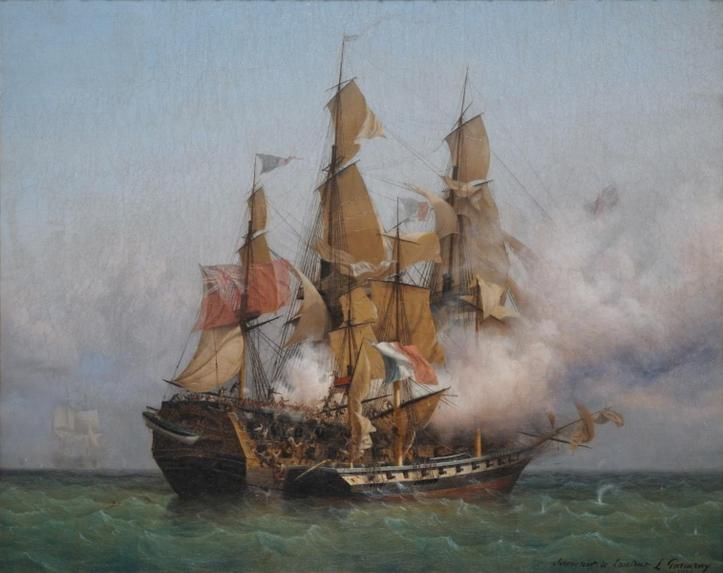
Top image: The British merchant ship Kent (left) attacked by the French privateer Confiance in October 1800. Painting by Amboise Louis Garneray.
 philahistory.org