
By MICHAEL SCHREIBER
Oak Street was one of the oldest thoroughfares in the district of Southwark, now a Philadelphia neighborhood known as Queen Village. The narrow street ran for one block between 4th Street and the Passyunk Road, and was the next street to the south of Cedar (now South Street). Both streets reflected William Penn’s system of naming Philadelphia’s east-west streets for trees.
But Oak Street was erased from Philadelphia-area maps in the early 1830s. At that time, buildings on its north side were demolished, and Oak Street was combined with Shippen Street (renamed Bainbridge Street in the 1890s), which earlier had been cut through just to its north. The widened street was given a strip of land down its center in order to accommodate market sheds—part of what was known as the Washington Market.
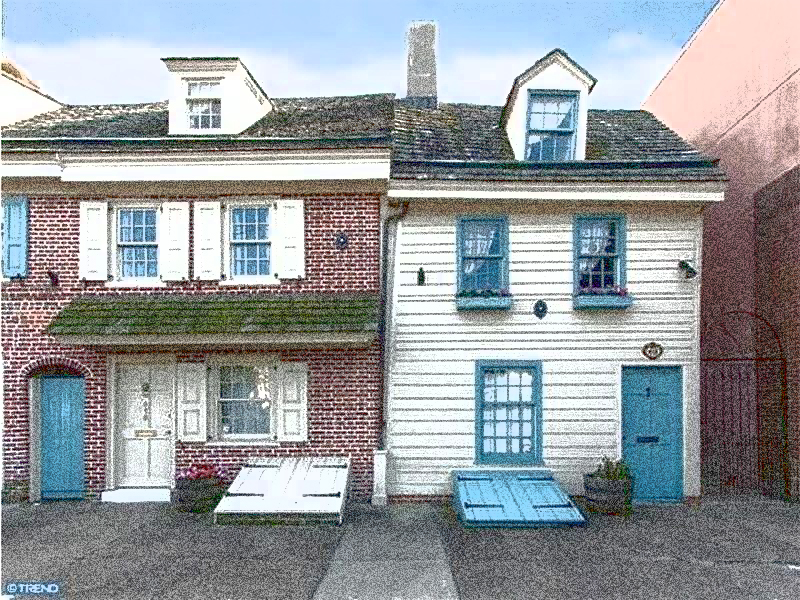
Nevertheless, relics of Oak Street still survive in a row of houses that are standing just east of Bainbridge Street’s triangle intersection with 5th and Passyunk. Today, the three oldest houses in the row are numbered 414, 416, and 418 Bainbridge Street. In 2014, Amy Grant and this writer, members of the former Southwark Historical Society, looked into the early history of the three buildings with an eye toward ascertaining how old they might be. We undertook our inquiry as a contribution to the plans that were underway at the time (though, sadly, not yet completed) to renew and beautify several blocks of Bainbridge Street in Queen Village under the aegis of “Bainbridge Green.”
One of our first stops was at the offices of the Philadelphia Historical Commission, but unfortunately, our visit to the city department turned up very little about the houses. Our main find there was a snapshot photo that showed 418 Bainbridge in the process of restoration; the building’s wooden sheathing was visible in the photo, after its modern covering had been stripped away.
Likewise, we were unable to find any fire insurance surveys for the buildings, which might have provided key data about when they were built and their original appearance.
In other archives, however—including the Pennsylvania Historical Society, the American Philosophical Society, and the city records department—we were able to sift through many deeds, wills, street directories, maps, and newspaper clippings from the 18th century, which offered information about the history of the Oak Street properties and some of their owners, such as the Shippen family. This article, which reflects our research, was first compiled in 2014 but never published; it has been slightly updated and posted for the first time in 2023.
By coincidence, at the same time that Amy and I undertook our investigation, the Philadelphia Inquirer (March 16, 2014) published a feature article on these houses, titled “Colonial trio with family history.” The article related how Homer and Helen Rhule had restored the houses in the 1980s; for many years they operated a bread-and-breakfast establishment called the “Shippen Way Inn” in the two westernmost houses. In 2014, the Rhule’s daughter, Ann Foringer, and her husband Scott and daughter Mai lived in the wooden-framed house furthest to the west. The Inquirer stated that that house was built about 1738—which was alleged to be more or less the date that the Philadelphia Historical Commission had determined at the time of the buildings’ restoration.
Amy and I realized that if the date 1738 were accurate, these houses would perhaps qualify as the oldest houses still standing in the Queen Village neighborhood! Unfortunately, we were unable to find any documentation that substantiates the date of 1738 for any of the houses. It appears that they are old—but not quite that old.
Extensive restoration
The amount of restoration applied to these three buildings in the 1980s, at least in the front elevations facing Bainbridge Street, was extensive. Much of the work was fairly standard, of course. Accordingly, the buildings’ modern window frames were replaced by wooden frames that were re-sized to be authentic to the period. But some of the stylistic details that were chosen raise questions about how much they reflect what the original buildings might have looked like.

For example, two of the restored buildings were given box-shaped dormer windows, which were common in the early 18th century, instead of the peaked roofed dormers that became popular by the 1760s. Also, the restorers built a pent roof above the ground story of 416 Bainbridge, even though pent roofs were increasingly rare on houses built after around 1770. And so, it is possible that the restored buildings were rendered in a style that by the last decades of the 18th century had already grown out of fashion. As a result, in our research, we were confronted by the realization that the houses might have been made to look older than they really were.
A close look at the facades of 414 and 416 Bainbridge might provide other clues as to the age of the buildings. Photographs of the buildings from between 1961 and 1972 (available at http://www.phillyhistory.org) show that at the time the façade of 414 Bainbridge was covered with stucco, while 416 had a surface of Permastone or a similar material. Comparing those photos with the appearance of the buildings today reveals that the alley separating the two houses ran beneath the second floor of #414, whereas the east wall of #416 bordered the alley to the west. Thus, 414 Bainbridge was slightly wider than 416, indicating that it is unlikely that they were built as a unit.
Today, however, the positioning of the houses has been changed. The wall between the two houses now appears to bisect the alley, while the courses of bricks are uninterrupted across the facades of both houses—as if they were built in tandem. This is an indication that during the process of restoration, the facades of 414 and 416 Bainbridge were virtually entirely reconstructed; new brick was laid. And although the brickwork weaves up and down in places, as if to account for three centuries of subsidence, there is reason to believe that the unevenness might be nothing more than an “aging” effect that the restorers deftly added to the façade during reconstruction.
Deed trail for the two brick houses
At the beginning of the 18th century, virtually all of the property along Oak Street was owned by the merchant Joseph Shippen (1679-1741), who owned other large tracts of land throughout what is now Queen Village. This plot was adjacent to the Great Passyunk Road, which had once been a trail through the forest for the native Lenni Lenape people and later for the early Swedish settlers. For most of the 18th century, the land surrounding the intersection of Oak and Passyunk consisted mainly of farms and horse pastures. Large country houses and “gentlemen’s” estates also dotted the area. Immediately to the north was the Charles Hurst mansion at the northeast corner of 5th and Cedar (South) Streets, across the street from the Southwark Theatre and where the Passyunk Road had its beginning. The house was built in 1775 and demolished in 1883. And not far to the south was Joseph Wharton’s sprawling Walnut Grove estate (the mansion was demolished in 1862), on a hill at today’s intersection of 5th and Federal Streets.
In 1738, Joseph Shippen willed that his land holdings be divided among his sons. According to the terms of the will, William Shippen (1712-1801) was to receive the large tract at what became the intersection of Oak and Passyunk. Two years later, apparently while his father still lived, William Shippen, and his wife Susanna began to sell off the land in smaller plots. In 1740, John Palmer, a wealthy bricklayer and architect whose fine house (built 1743) still stands near 2nd and Lombard Sts., purchased a plot just to the east of the three present houses. The same year, the merchant Joseph Hitchcock purchased a plot of land slightly to the west—what later became part of the Shippen Inn. In 1744, Hitchcock sold the plot to another merchant, Robert Grace.
Grace’s property was seized in a sheriff’s sale and auctioned to Robert Meade and John Reilly. Some years later, Meade and Reilly sold the property to John Bates, a shoemaker. In 1774, Bates’s property was seized by the sheriff and sold to John Keist (in sale advertisements, a stone kitchen is mentioned on the grounds). Keist died intestate soon afterward, and the land went to his cousin, Thomas Booker.
In 1780, Booker sold the land to James Durant, who soon had a house built there. The tax rolls for 1783 show him paying £90 in taxes for the house and land. In 1785, Durant sold the eastern half of the property to William Mullin (also spelled Mullen, McMullen, etc.), who appears to have been a friend since he signed as a witness to Durant’s 1780 deed. Mullin’s house was built soon after this. The Southwark tax rolls for 1785 show Durant paying £100 for his house, and Mullin paying £75 for his slightly smaller dwelling. The properties were soon given addresses: Mullin lived at 14 Oak Street for the next two decades, and operated a grocery store there as well as his shoemaking business. Meanwhile, Durant lived at 16 Oak Street until his death in 1794. His widow, Elizabeth Durant, continued to live at #16 afterwards, and is listed in directories as running a tailor’s shop and grocery on the premises from 1798 to 1804.
During these years, Oak Street held at least a dozen small houses that were rented by people of various trades—including several shoemakers, a schoolteacher, laborers, porters, carpenters, and widows. John Hills’s 1788 map of Moyamensing, Southwark, and Passyunk appears to show a row of buildings in the vicinity of this location.
Joseph Scull’s grand country house
As mentioned above, the major purchase from Shippen took place in 1742, when rope maker Joseph Scull bought land at the corner of Oak and the Passyunk Road, extending 100 feet along Oak Street, and 65 feet on Passyunk. Scull was the youngest son of Nicholas Scull, a Quaker surveyor who came to Philadelphia in 1685. Nicholas’s six sons and one daughter (Mary, wife of William Biddle) left the Society of Friends and joined the more fashionable Anglican congregation of Christ Church.
Joseph Scull managed the rope-making operation at the Philadelphia workhouse, where indigent men and woman were given tasks to “earn their keep.” A couple of years after he purchased the Oak Street property, in 1744, he became the city’s undersheriff, while his older brother, Nicholas Scull Jr., served as sheriff. Nicholas Jr. also became Surveyor General of Pennsylvania, and is responsible for early maps of the Philadelphia area that are often reprinted.
About a year after his purchase (ca. 1743), Joseph Scull built a grand house on the land. It was a large three-story brick building, which faced the Passyunk Road but was set apart from the noisy roadway by a garden (located on the corner where the 20th-century classical-styled bank now stands). The main residence sprawled a full 32 feet along Oak Street, with an additional 20-feet-long kitchen adjoining it in the rear. The kitchen door opened onto a paved yard with “a well of good water” within it. Also on the property were a stable and stable yard, coachhouse, hayloft, washhouse, “out offices,” and ample horse pastures. It was all that a “gentleman” and his family could dream of—a sizable rural estate situated within an easy coach ride (or even walking distance) of the city.
But Scull did not live there very long. Soon after completion of the house and improvement of the grounds, around 1744, he sold it all to the merchant Robert Grace. But Grace rapidly fell into bankruptcy; the land was subdivided and parcels were sold off by the sheriff.
In August 1746, the county sheriff auctioned off the house and grounds to Maurice and Edmund Nihell, who were import merchants and also owned a malthouse and brewery on Sixth Street, near the State House. The Nihell brothers saw the big house at Oak and Passyunk as a rental property, but within the next five years, they too fell into debt. In a newspaper notice from July 1751, Edmund Nihell stated that he was forced to sell his own residence, the malt house, a horse and wagon, several cows, and even the indenture of his servant. And in May 1752, the house and grounds at Oak and Passyunk once again went on the auction block.
The property ended up in the hands of the merchants Garret Meade and John Reilly, who around the same time purchased the adjacent parcels from other owners. Eventually, Meade, Reilly, and other partners had recombined the land once attached to the old Joseph Scull mansion, and owned almost the entire block along the south side of Oak Street. In 1759, they sold it all to Robert Kennedy, who moved into the house.
Robert Hardie, sea captain and patriot
In 1764, Robert Hardie purchased the house from Kennedy. Hardie was a sea captain in the trans-Atlantic trade, and responsible for bringing great numbers of immigrants from Europe to Pennsylvania in his vessel, the Patty. Hardie had a new kitchen built behind the main house and along Oak Street. Also in 1764, he purchased the property just to the west of his house (18 Oak Street, where the small wooden-framed building stands today).
Soon after his purchase, Hardie advertised that all of the buildings on the property were available for rent, including the main house and a “daughter house and other wooden tenements.” He stated that the “commodious” three-story residence was “very fit for a gentleman’s house, having a fine prospect of the country on one side, and a fine view of the city on the other.” Moreover, “it is very fit for a tavern, a baker, or a man who follows carting.”
However, in June 1764, Hardie decided to move his own family into the upper floors of the “gentleman’s house.” In the meantime, on the ground floor, he set up a shop to sell both “wet and dry goods,” both wholesale and retail. He advertised a broad array of commodities for sale—Jamaica spirits, wines, vinegar, molasses, sugar, rice, stockings, breeches, umbrellas, handkerchiefs, knives, buckles, scissors, and much more. Hardie even kept a horse and chair on the premises to lease to those who required transportation. Unfortunately, late one night in October of that year, a thief entered the grounds and stole Hardie’s sorrel mare.
After a few years, Capt. Hardie and his family moved to Spruce Street, where they relocated the store. The main house was leased to Patrick Byrne, who operated a well-known tavern there while living upstairs.
In 1774, the captain attempted to sell the entire property, and tried again with redoubled effort in 1777, (see ad in the Philadelphia Journal and Weekly Advertiser, April 9, 1777). The grounds that were for sale extended along Oak Street for 120 feet. They included the main house (which extended 32 feet along the street), followed by the kitchen (about 14 feet wide), a rear yard and water pump opposite the kitchen door, two brick two-story houses with garrets (each 18 feet wide), and one wooden one-story house with a garret, paved cellar, and fireplace (13 ½ feet wide). That last house appears to be located at 18 Oak Street (today 418 Bainbridge), although the present building is 2 ½ stories, not just 1 1/2.
But no sale could be made in 1777. It was wartime, and within months, the city would be occupied by the British. At the time he placed the ad, Hardie was serving as commander of the Pennsylvania Navy armed galley Terror, in order to counter British warships in the Delaware. In August of that year, at age 50, Hardie was appointed commander of the galley Burke, but soon was arrested for disobeying orders. At his court martial hearing, in December 1778, Hardie maintained that the commodore of the fleet had refused to provide any relief for the enlisted men on the Burke, who were exhausted. After the commodore had denied his requests on behalf of the crew, Capt. Hardie ordered the craft to proceed to Bristol (presumably for the men to enjoy a rest), whereupon he was arrested. His confinement in jail lasted several months.
In his appeal, Hardie protested the injustice of a trial in which he, a sea captain with decades of experience, had been convicted by a court of youngsters, including the son of the commodore, who knew very little about nautical or military matters. He denounced the situation in which the “Visionary Phantoms of their Childish Brains” had branded him as “A Dangerous Enemy to the United States,” when in fact he had been among the first to embrace the cause of American independence, had risked his life together with his men, and had donated a considerable portion of his personal funds to the revolution. He complained also that he had been denied any salary, even though he had a wife and children to support—while the British had despoiled his houses in Philadelphia. Now, he said, he was financially ruined.
After the Revolution, Hardie attempted to obtain additional compensation for the injuries he had sustained during battle. But his appeals to the Pennsylvania legislature seemed to fall on deaf ears. As late as 1785, he was still fighting for a hearing. Finally, in December 1785, it was confirmed by a House committee that since records showed that Hardie had been court-martialed for disobeying orders while in action, he could now only be considered a common citizen, and not on the same footing as other former officers of the Pennsylvania Navy. Therefore, his application for compensation for his wounds was denied.
In the years after the Revolution, Hardie—now fairly old and financially crippled—left the sea and worked on the docks as a measurer of tonnage. However, in street directories just before his death, he is still listed as a “shipmaster,” a sign of some respect. He moved back to Oak Street, living in the smaller “daughter house,” next to the main house.
In 1791 and subsequent years, he advertised that the entire main house was for rent, and that he could be contacted for particulars at his living quarters next door. He emphasized that the building was suitable for a gentleman’s family, while being well positioned for commercial uses, since it lay on the main road into the Neck (today South Philadelphia). Hardie noted that it had been used in past years as a grocery store as well as a tavern (see the ad, for instance, in Claypoole’s Daily Advertiser, Feb. 3, 1796). In August 1798, a little before his death, Hardie crowed that some 1200 people were estimated to pass the house every day! At the same time, he said, the situation of the house was “airy and healthy,” and there was a pump of “excellent water” in the yard by the kitchen door (The Philadelphia Gazette and Daily Advertiser, Aug. 29, 1798). In the meantime, Hardie continued to rent out the other buildings he owned along Oak Street. In Philadelphia street directories of 1791, for example, John Cake, a shoemaker, is listed as a tenant at 18 Oak Street.
Capt. Hardie died at the end of December 1798; he was 81 at the time. The property was bequeathed to his son in law, David Graham. The northern portion of the land (pastures and outbuildings) had already been sold to Michael Walsh. After Graham’s death in 1807, the property was taken by the sheriff, sub-divided, and auctioned off.
An ad in the Aurora (Jan. 7, 1807) lists the properties to be auctioned. The main property, on the corner, was a square of about 68 feet by 68 feet and contained the three-story main house and two-story kitchen, and perhaps other buildings. Also for sale, but separately, was a two-story brick building to the east along Oak Street; the property began about 100 feet to the east of the Passyunk Road. This house (18 Oak Street) was bounded on the east by the house owned by the heirs of James Durant (16 Oak Street, still standing today), and on the west by another brick house (20 Oak Street), which had an alley next to it.
Unfortunately, the description of the small house that is for sale is not entirely clear. It appears by its location to be the wooden-framed house at 118 Bainbridge Street that stands there today. Tax rolls from 1787 also describe the house as being “frame,” i.e., constructed out of wood. However, it is described in the 1807 advertisement as being constructed of “brick,” not wood. Was the description of the “brick” building made in error?
THE VERDICT: There is no evidence to verify the opinion expressed in The Philadelphia Inquirer article that any of the three houses were built as long ago as 1738. No deeds or documents that we have found mention any structures on the land for at least the next three decades. Ads in 1774 for the auction of the property where the two brick houses (414-416 Bainbridge) now stand state that there was a “stone kitchen” there at that time, but it is possible that this was a mistaken reference to the kitchen on Robert Hardie’s estate, which was close by. In the 1780s, James Durant purchased the land. We think it is likely, based on deeds and tax rolls, that his brick house was constructed around 1780-83. Mullin’s house was built in 1785.
The wooden house (418 Bainbridge) stands on the property where Capt. James Hardie listed a one-story wooden house for sale in 1777. During Hardie’s time of ownership, a building in this location was rented out as a dwelling (i.e., to the shoemaker, John Cake in 1791). However, descriptions of the building are inconsistent, as described above.
Thus, it is quite possible that 418 Bainbridge, or a portion of it, dates back to 1777, and perhaps even to a decade earlier during Capt. Hardie’s ownership. It will require more investigation to pin down the circumstances of this building’s construction more precisely.
 philahistory.org