
By MICHAEL SCHREIBER
It is thought that several thousand graves exist on the grounds of Gloria Die (Old Swedes’) church in Philadelphia; the earliest burials took place in the last decades of the 1600s. But over the centuries, the majority of headstones have disappeared from view. Those that survive are often broken or chipped, while a great many of the inscriptions have become unreadable due to air pollution caused by industry and traffic in the city.
In recent weeks, a new permanent exhibit has been mounted on the wall of the rectory at Gloria Dei (Old Swedes’ Church) in Philadelphia. The “Memory Wall” contains over a dozen fragments of old gravestones, generally dating to the 18th and early 19th centuries. Some came from stones that were crushed when a nearby factory building collapsed in a fire in 1944. These shattered pieces, which had been strewn about on the ground, have now been collected in one place for public viewing.
One of the fragments on the Memory Wall came from the stone that used to stand over the graves of Davis Denike and his wife, Elizabeth (Suter) Denike. The lettering on its face is obliterated. However, as transcribed by the historian Park McFarland in 1877, the inscription once read:
Sacred to the memory of Elizabeth Denicke wife of Davis Denicke who departed this life June 1st 1829 aged 55 years 10 months and 28 days In she I lost a mother dear a loving wife a friend sincere
Also Davis Denike Born June 26th 1762 Died February 14th 1838 aged 76 years.
Although that brief inscription honored the devotion shared by Davis and Elizabeth, it barely touched on their life stories. Documents show that Davis Denike fought in the American Revolution as a young man; later, he became a sea captain. Unfortunately, much less is known of Elizabeth.
Chestnut Neck
Davis Denike was born close to the ocean shore in the eastern part of Gloucester County (now Atlantic County), N.J. He was from Chestnut Neck, a small hamlet in the vicinity of the marshy barrier islands surrounding Little Egg Harbor. The village served as a port on the winding Little Egg Harbor River (now the Mullica River*), near where it flows into the bay.
Even today, many of the islands, peninsulas, and sand bars surrounding Little Egg Harbor are fairly inaccessible except by boat. The salt marshes seem to extend to the horizon—although they have greatly eroded in recent decades due to storms, boat wakes, and the sea-level rise driven by climate change.
The surrounding area was settled by Swedish immigrants in the late 17th and early 18th centuries. A wave of New Englanders migrated to the area in the early 18th century. The people earned their living through a variety of means—including fishing, crabbing, clamming, small farming, lumbering, and boat building. Whaling was a common occupation; men would launch their small boats to capture the whales once they were sighted swimming off shore.
Early in the 18th century, ocean-going pirates found a haven in the Little Egg Harbor area; they were lured by the narrow entrance channel and the secluded back bays. And even after the age of piracy faded away, the area remained a refuge for home-grown smugglers. Deeper into the “pine barrens,” among the settlers and squatters in log cabins, dwelt the rough and notorious “swamp men,” who often lived by thievery.
Important industries were also established in the region. Upstream near the forks of the Mullica River, the Batso iron works was founded in 1766, making use of bog ore and charcoal from the abundant forests. The enterprise assumed major importance during the American Revolution for the production of cannon balls and metal implements. Meanwhile, in the estuary, salt mining took place, which was essential for preserving meat and other foods.
By the beginning of the American Revolution, Chestnut Neck, named for a grove of chestnut trees, was a village of about 11 wooden houses, three warehouses, and the tavern run by George Payne. According to some accounts, Samuel Denike, Davis’s father, partnered with Payne in running the tavern. Around 1777, a second tavern opened in the village to handle the swarms of seamen and smugglers who frequented the Little Egg Harbor area.
Despite its diminutive size, Chestnut Neck was a center for shipping activities. Smuggling was what the locals simply called “trade.” Their chief imports were sugar and molasses, which were generally obtained in the French and Spanish-owned islands of the West Indies—thus avoiding export taxes levied by British colonial possessions. In exchange for these items, the traders often sold lumber—Atlantic white cedar from the swamps along the shore and pine from the upland forests.
Once the smuggling vessels had returned to the back bays of the New Jersey coast, where they could avoid customs agents, the sugar and molasses were often rowed up the Mullica River and other creeks and into New Jersey’s heavily forested interior. The merchandise was then loaded onto carts, where it might have been buried under loads of clams, oysters, or farm produce as a disguise.
Much of the sugar and molasses was hauled through the forest and under cover of night to ports like Cooper’s Ferry (now Camden, N.J.). From there, it was transported across the Delaware River into Philadelphia, where it could be refined into rum. Many Philadelphia merchants used the rum to trade for products in Europe and elsewhere.
As the British Trade and Navigation Acts took hold in the 1760s, it was natural that resentment increased among many people in the Little Egg Harbour area, since it thrived on the import/export trade. The Sugar Act, the Stamp Act, and the duties on tea, paper, glass, etc. contained in the Townshend Acts increased the costs of everyday goods and only increased the anger among both sellers and consumers. Although Parliament repealed most of the provisions of the Townsend Acts in 1770, three years later it rescinded the duties paid by the British East India Company on its tea, thus undercutting the price of smuggled Dutch tea in the American colonies. Protests erupted across the Eastern Seaboard; tea shipments were highjacked and destroyed, most notably in the Boston Tea Party but also in New Jersey and other places.
As the war began with Britain, many of the ship owners and maritime traders and smugglers turned to privateering. The Chestnut Neck privateers cruised off the New Jersey coast among a stream of British merchantmen, many of which were bringing supplies to British forces in New York. Sometimes, the local privateers had to compete with privateers from Philadelphia and the Delaware River—or even with vessels from New England. Nevertheless, the profits from selling captured vessels and their cargoes could be quite high. When the cargoes were sold, the profits were divided among the owners of privateering vessels, captains, crews, and government entities.
Chestnut Neck was an important site for the sale of prize vessels and their cargoes, and the village’s three warehouses were often filled with captured merchandize. According to Norman Goos, a historian for the Atlantic County Historical Society, “Chestnut Neck becomes the largest privateering port to dump the captured vessels and their loot between Boston and Charleston, South Carolina. And so you sometimes have six and eight ships a week being sailed in” (https://shorelocalnews.com/research-sheds-new-light-on-atlantic-county-revolutionary-war-heritage/).
But the risks were considerable. The dangers of privateering were seen on April 17, 1777, when Capt. Timothy Shaler of Connecticut, sailing in the Lion off Sandy Hook, seized the Hazard, carrying a cargo of coal, and towed the prize toward Egg Harbor. However, a British frigate, Mermaid, was quickly dispatched from Sandy Hook to pursue Shaler. During the chase, the privateer and her prize grounded in the shallows off Long Beach Island, north of Little Egg Harbor, where the Mermaid was able to destroy both vessels.
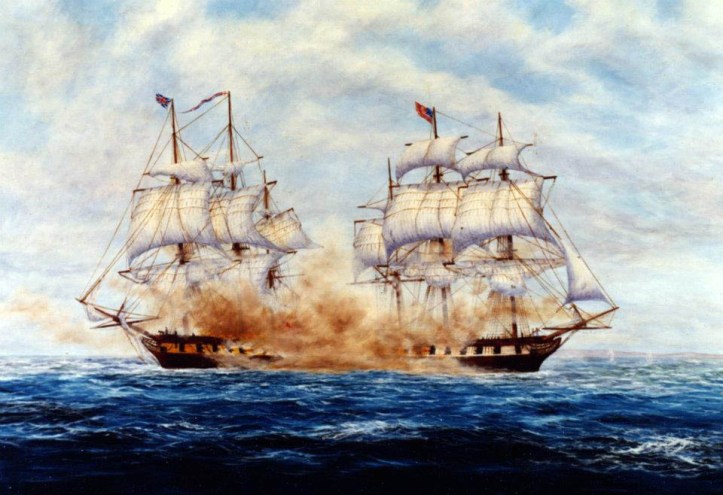
Fortunately, the local people were able to share in the profits from both wrecks. In May 1777, the Pennsylvania Journal advertised the sale of “the remains of the brigantine Hazard … captured by Captain Timothy Shaler” with “6 swivel guns, small arms and equipment, food stuffs.” On July 3, the Pennsylvania Evening Post advertised that material from the wrecked Lion would be sold at George Payne’s tavern in Chestnut Neck. For sale were “her hull and some spars & c. as they now lie on Long Beach” along with “eight excellent double fortified four pounders,” swivel guns, blunderbusses, cutlasses, musket balls, surgeon’s instruments, a medicine chest, rigging, flags in “Continental and English colours,” and many other articles.
These were the conditions at Chestnut Neck, N.J., when, in 1777, a local teenager, Davis Denike, joined the fight for independence from Britain.
Militia and privateering
In early December 1832, Davis Denike, now 70 years old, applied for a U.S. pension. Just a year earlier, Congress had authorized such pensions for the rapidly dwindling number of Revolutionary War veterans. Denike’s recollections of his military service were contained within his pension application (viewable on the fold3 website); he also maintained that he had documents in his possession that would verify his account. Three weeks later, Davis’s younger brother, Samuel Denike Jr., also testified about his experiences during the Revolution while applying for his own veteran’s pension from the government. Samuel’s testimony backed up his brother’s story in many respects since they had served together in some of the same fighting units.
In addition, Davis Denike’s account was verified in a sworn deposition by Henry Davis, a resident of Gloucester County who had known Denike since they had both been very young. Henry Davis testified that he had fought side by side with his friend in numerous engagements. In 1780, both were captured and confined on the prison ship Jersey.
Davis Denike related that in the spring of 1777 at Chestnut Neck, he joined the 3rd Battalion of the New Jersey militia—sometimes called the Egg Harbor Guard. Denike said at the hearing that he was 17 at the time, although if he was born in 1762, he would have been only 15.
The 3rd Battalion was a marine unit, whose assignment was to provide intelligence on British movements along the coast, harass enemy shipping, guard against the actions of armed Loyalists, and aid the Continental troops on land when called upon. This militia battalion was formed in 1776 in the eastern part of Gloucester County and along the Jersey shore; in December of that year, it fought along with Continental Army and other militia troops at Mount Holly, Trenton, and Princeton. They then spent time with Washington’s army at their winter quarters in Morristown. About 250 men were serving in the battalion.
The commander was Col. Richard Somers, a Quaker from Somer’s Point, N.J., although Denike’s pension application identifies the colonel as [Thomas] Proctor. The misidentification might not have been Denike’s error but that of the clerk who transcribed his testimony. Col. Thomas Proctor, of Philadelphia, commanded a Pennsylvania-based artillery regiment of about 100 men that often operated together with the New Jersey militia in Gloucester County and nearby areas.
Soon after the local militia had returned to the Atlantic coastal area, Denike joined them. He was assigned as a drummer to the locally based militia company under George Payne, the tavern keeper, for a period of nine months. Payne was assisted by Lt. Abraham Davis (1740-1792), a Chestnut Neck resident who had enlisted in the New Jersey militia as early as November 1775. Davis had previously shipped lumber to the West Indies as a participant in the smuggling trade. His father, William Davis, had emigrated from Wales to Nantucket, Mass., where he had engaged in whaling. He then moved to Chestnut Neck, where he began the family business of exporting lumber.
Samuel Denike Jr. affirmed in his pension application that he joined the same company as his brother. He was probably about 13 at the time. Samuel stated in 1832 that he could not remember his exact age, and that all of his birth records had been destroyed when the British burned down his father’s house in Chestnut Neck in 1778. Henry Davis (one of Abraham’s brothers?) also enlisted in the company as a private.
Soon after the Denike brothers joined the militia, Capt. George Payne was promoted to colonel, and the company command was taken over by another captain, Nehemiah Morss (sometimes spelled “Morse”). The unit was sent by boat to the island of Fox Burrow, where they assisted in the construction of a small enclosure called Fort Tucker. The Rev. Norman Goos, historian of the Atlantic County Historical Society, notes that this appears to have been an observation post to look out for British warships about to invade the harbor.
The war-time conditions along the New Jersey coast can be glimpsed in the following letter, dated July 24, 1777. It describes how people from the Egg Harbor area (quite likely from the marine militia that Denike had joined) were able to rescue the cargo of an American schooner returning from a trading voyage to Martinique after it was chased by British warships. The letter was reprinted in the Pennsylvania Gazette of July 30, 1777: “We should have sailed this day had it not been for an alarm we had yesterday, which diverted the people’s attention from work: — About one o’clock we heard a smart firing of cannon, and soon after were informed that several vessels were off the beach, about four miles to the Southward of this place; we soon discovered the enemy had been in chase of a small schooner and drove her ashore. A frigate of 32 guns came up and anchored about three quarters of a mile from the shore, two tenders and three barges came much nearer, and all kept up a steady fire for four or five hours on the shore, without doing any damage, nor did it prevent the people from landing chief part of the goods that were on board; at high water the schooner bilged, the remainder of the cargoe was drove on shore and secured, it consists of rum, molasses, sugar, limes and dry goods.
“About seven o’clock another frigate came up and anchored off the beach; from the preparations we discovered them making, expected they would land in the night, we made a tolerable good breast work of the rum casks and sand, and were determined to prevent their destroying the goods; however, they were disappointed in their design from the wind blowing hard from the North West, which obliged them to stand to sea, since which we have not discovered any more of these plundering pirates.”
After Davis’s nine-month tour of duty had concluded, he left the militia, although his brother remained in George Payne’s company for more than a year more. Davis Denike went on to enlist for about two months as a pilot on an 18-gun brig, which I have been unable to identify. He then served on board the schooner Lexington, commanded by Capt. John Cook of Toms River, N.J.; the privateer was harassing British shipping along the New Jersey coast. The Lexington was dispatched by General Washington to sail to Sandy Hook, in northern New Jersey, in order to greet the French commodore Count De Grasse and to help local pilots communicate with and guide the arriving French fleet. Davis Denike served as a pilot during that cruise, which lasted six weeks before returning to Egg Harbor. His brother, Samuel Denike, was also on the Lexington, for about four months.
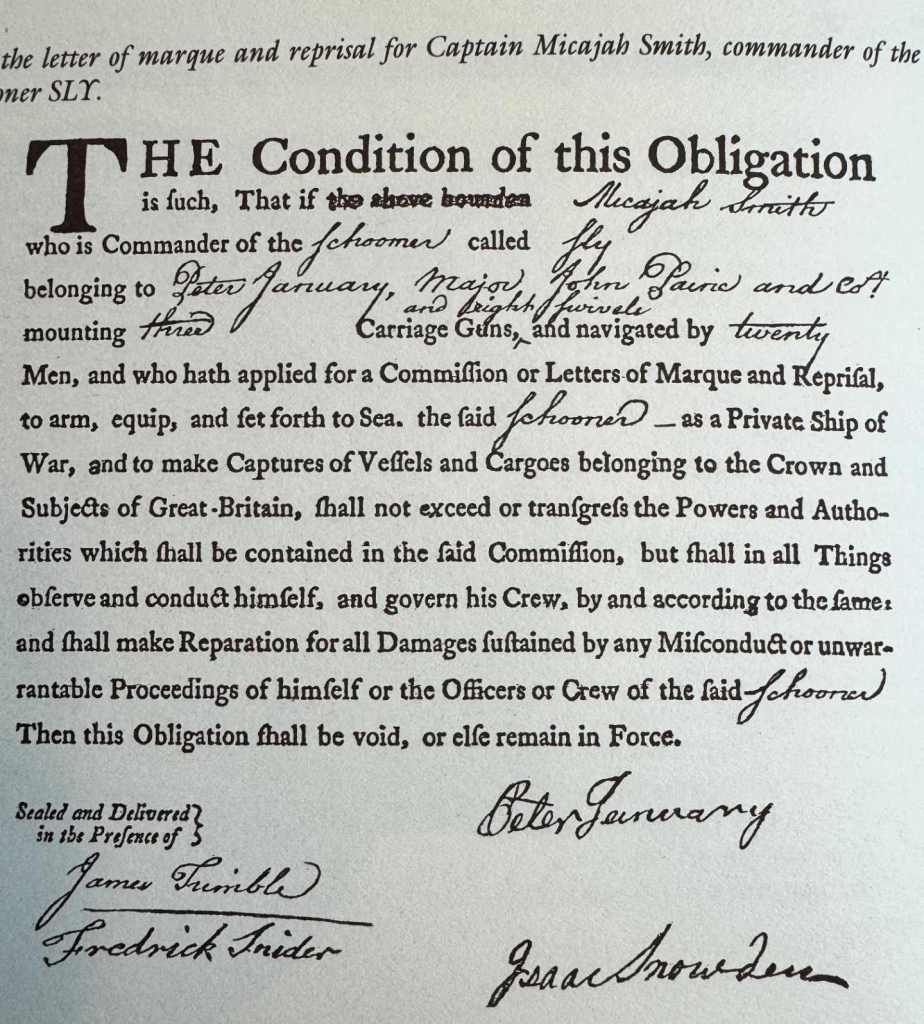
Later in 1778, both Denike brothers transferred to the schooner Sly, commanded by the local privateer, Micajah Smith. The vessel is alternately referred to as the Fly in some historical accounts, but a document appears to indicate that Smith was master of a Pennsylvania schooner called the Sly, which was granted a Letter of Marque on July 31, 1778. The Sly (or Fly) carried three guns and a crew of 20 (see “Naval Documents of the American Revolution,” p. 295).
Davis Denike worked as a gunner on the vessel for several cruises, in which they frequently exchanged shots with British warships. In their most famous—and profitable—encounter, on Aug. 26, 1778, the Sly (or Fly) accompanied the sloop Chance when they captured the Venus, a merchant ship bound to New York City from England. While boarding the Venus, Denike was wounded in the left hand after being swiped by a cutlass. The blow left a scar that remained visible for the rest of his life. The captain of the Venus, Thomas Chowne, was sent to jail in Philadelphia, while his vessel was towed into Chestnut Neck.
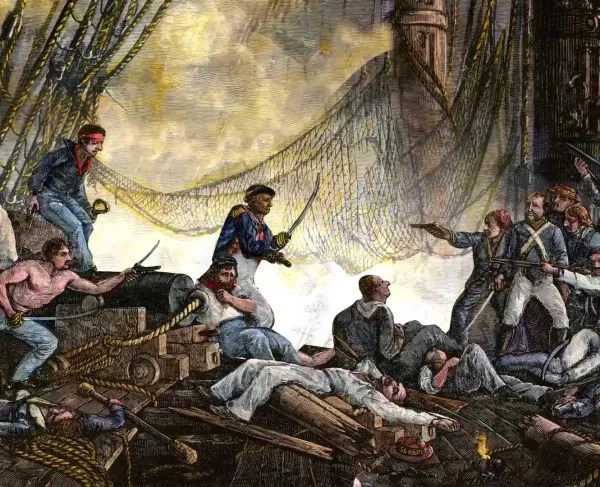
After taking the Venus, the privateers discovered that she held a cargo of sugar as well as many dry goods and luxuries—products that were no doubt coveted by the wealthy Loyalist families in British-occupied New York. The Pennsylvania Packet (Sept. 10, 1778) described the cargo in detail, no doubt with the realization that many of its readers in Philadelphia were enduring wartime shortages and had recently suffered under the depredations of British troops. The newspaper reported that it consisted of “fine and course broadcloths, fine and coarse linens, calicoes, chintzes, lawns and chambricks, silks and satins, silk and thread stockings, men’s and women’s shoes, a great variety of medicines and books, hardware, beef, pork, butter, cheese and porter, in short, the greatest variety of all kinds of Merchandise.”
These commodities were sold at week later at public auctions at Payne’s Tavern in Chestnut Neck and at Richard Wescoat’s tavern at The Forks, further up the Mullica River. The sale of the cargo amounted to around £20,000, while the Venus herself sold for over £17,000. The totals would equal close to $8 million dollars in today’s money.
Unfortunately, the sale was never completed, since the claims of the captains—David Stevens on the Chance and Smith on the Sly (Fly) still needed to be adjudicated. The New Jersey Gazette reported on Sept. 23 that an admiralty court would be held in Allentown, Pa., on Oct. 10 to hear Stevens’ and Smith’s claims to the vessel and its cargo—as well as any counterclaims. Before the hearing could take place, however, the British raided Chestnut Neck and destroyed the Venus and part of the cargo (see below).
Serving under Stevens on the Chance was his brother in law, Abraham Davis, formerly the lieutenant under George Payne when Davis Denike first joined the militia. One story of the Chestnut Neck privateers was handed down, probably orally, in the Abraham Davis family. The tale was set down in writing in a 19th-century autobiography by Davis’s grandson, George W. Davis. In this passage, he wrote about his ancestors during the Revolution:
“My grandfather and his brother-in-law, of the name [David] Stevens …” George W. wrote, “conceived the project of … fitting out a private armed vessel and cruising against (British) commerce … This scheme met but little encouragement from their friends who thought they would find difficulties and dangers that were insuperable and hence would not join them in the enterprise nor give them aid in the undertaking.
“Both the two men were too sanguine of success to be stopped or discouraged and, relying on their own limited resources, fitted out a kind of galley or barge. It was the best they could do and having mustered twenty-five young, reckless, daring and enterprising men like themselves, Stevens, the commander, and my Grandfather, Lieutenant, they put to sea. Their armament was one cannon mounted on midships and muskets, cutlasses and pistols sufficient for their crew.
“After cruising two or three days on the coast … they found themselves one very foggy morning in the midst of a fleet of British Merchantmen conveyed by a Frigate. As the fog thinned off, they discovered themselves close alongside and under the guns of the Frigate. An officer on board the Frigate saw them, and supposing it was a launch or tender belonging to his fleet ordered them to drop astern, to which they answered, in sailor phrase ‘Aye, aye, Sir!’ and accordingly dropped astern and kept gradually dropping back until they came alongside of [one of the merchantmen], and she … had no alarm until they had grappled her and were on her deck with their cutlasses and pikes. So without firing a gun, they took her, the men running down below.
“She proved to be a transport from Ireland—deeply laded with provisions—a valuable cargo. They ran her into Little Egg Harbor, Chestnut Neck; sold the cargo at auction for a good price and divided the large share of the prize money to each man. This success, so complete, so unexpected, gave an instant impulse to the business, and my Grandfather and Stevens had each of them a handsome privateer of fourteen guns immediately outfitted by the merchants of Philadelphia … They (subsequently) took a great many valuable prizes and the two commanders, Davis and Stevens, each made handsome fortunes”(see: https://jonnesgenealogy.com/abraham-davis-in-revolutionary-war-privateer/).
Unfortunately, the circumstances and time frame of George W. Davis’s tale is difficult to ascertain. It might be related to this item in the New York Gazette and the Weekly Mercury of April 8, 1778: TRENTON, APRIL 1 … Last week a brig from Ireland bound to New-York, with a large quantity of linen, butter &c. &c. was taken off Egg-Harbour, and carried into a safe port. The sailors and several other persons, who were made prisoners in the brig, were brought to this town [Trenton] yesterday.”
Some elements of the story as told in the autobiography are difficult to reconcile entirely with Davis Denike’s pension testimony and with other accounts. For instance, the letter of marque that Congress gave to David Stevens on July 16, 1778, for the Chance states that the sloop had two guns, not 14. And a later letter of marque that Abraham Davis received for the Fly on June 7, 1779, stated that she had six guns (increased from three guns when she sailed under Micajah Smith a year earlier), but not 14.
After four months on the Sly, in the autumn of 1778, Davis Denike said on his pension application that he enlisted on the sloop Hornet, which was also commanded by David Stevens. In his pension hearing, Denike affirmed that “he acted in any capacity in which he could be useful.” He stated that the Hornet carried 10 guns, but the letter of marque for the sloop that was granted to David Stevens on Sept. 21, 1778, states that it had 18 guns and 50 men. The letter of marque was granted on Sept. 21, 1778, almost a month after Stevens’ vessel, the Chance, had captured the Venus.
Denike described a battle between the Hornet and an armed British sloop called the Lady Longtail, with 14 guns. He remarked that although they were unable to capture the sloop, they damaged her to the extent that the enemy vessel had to sail to British-occupied New York for repairs. (Unfortunately, I can find no record of a 14-gun vessel called the Lady Longtail.)
Denike affirmed in his pension hearing that after working on the Hornet for at least five weeks, he sailed on a vessel called the Yankee Witch, carrying one four-pounder and 12 swivel guns, under Capt. Palmer. Denike said that he served as the prize master on the voyages, which supposedly took another five weeks.
I have not yet found references to a privateering vessel called the Yankee Witch. However, Library of Congress files published in “Naval Records of the American Revolution,” p. 325, show that during that period Thomas Palmer of Philadelphia was master of a one-gun schooner called the Hannah and Sally, owned by Matthew Irwin and Robert Bridges & Co. On Oct. 27, 1778, Congress granted the schooner a Letter of Marque authorizing privateering cruises, with Palmer and Timothy Matlack as witnesses. In his testimony a half-century later, was Denike confused on the name of the vessel he had served on in the autumn of 1778?
The Battle of Chestnut Neck
A few weeks before that, the British decided to mount a surprise attack on Chestnut Neck. In August, privateers from the area had captured around 30 British vessels off the New Jersey coast, and apparently, the British colonial administration considered the seizing of the Venus on Aug. 26 to have been the last straw that warranted retaliation.
Lord George Germain, the Secretary of State for the Colonies in London wrote to General Henry Clinton, the commanding general of the British Army in America, ordering him to “embark the body of troops to attack the ports and destroy all ships and other property alongshore, so as to incapacitate the rebels from continuing their depredations.”
Clinton wrote back to Lord Germain about his plans: ”I propose taking a forward position with the Army in Northern New Jersey [as a decoy to avoid a counter-attack by Washington] in order to favor an expedition to Egg Harbor, at which place the enemy has a number of privateers and prizes and considerable salt works. … Accordingly, I requested Lord Cornwallis to take a position in Jersey.”
Accordingly, while Cornwallis moved forward with 4000 troops as a diversion in Northern New Jersey, Clinton ordered 13 warships carrying close to 1400 soldiers to sail down the coast to Egg Harbor in order to “clean out that nest of Rebel pirates.”
As it turned out, American spies had swiftly learned of the impending attack. Washington’s generals mobilized troops to try to meet the British after they landed at Chestnut Neck, but they realized that they might not get there in time. Luckily, storms in the Atlantic delayed the passage of Clinton’s fleet, and it took over four days for it to sail down the New Jersey coast. That gave the Americans additional time to try to rally troops in defense and for the mariners at Chestnut Neck to move some of their prize vessels further up river. In addition, four privateer sloops were able to escape to the open sea before the British arrived.
Maj. Gen. Benedict Arnold wrote to George Washington: ”I was informed that the enemy meditated an attack on Little Egg Harbor. … Col. Proctor’s regiment (artillery) was ordered to march immediately for the defense of the place and the next day I sent one hundred militiamen (Philadelphia) to reinforce him. Col. Proctor reached the neighborhood of Egg Harbor Oct. 7th where he was joined by only 50 militia (from Philadelphia), although they had been ordered out four days before.”
But Proctor’s troops were two days late. The British flotilla passed through the passage into Little Egg Harbor on Oct. 5. On that day, a letter of alarm was rushed to Philadelphia: “The enemy have made their appearance, and are coming in — There are to the number of twenty sail — two frigates, several brigs, sloops and schooners, and three row-gallies with lattinne sails. Several sail of vessels are here, and nothing to protect them. All possible assistance is expected from you” (reprinted in the Maryland Journal, Oct. 13, 1778).
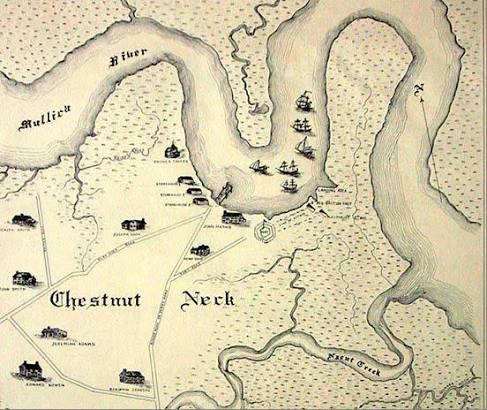
Because the larger warships could not clear the shoals in the bay, the British unloaded some 300 men onto the galleys—which were equipped with cannons—and rowed into the Mullica River. They arrived at Chestnut Neck in the late afternoon and quickly discovered that the two American forts in the area were armed with fake cannons (painted logs) and could offer no resistance. The British fleet proceeded to cannonade the village and the two forts.
The local New Jersey militia had been mobilized to repel the invasion, but the British firepower was too much for them and they were driven into the woods. The British boats then moved further up the river, landed the troops to the west of Chestnut Neck, and swept through the village. The Redcoats set fire to practically every building in the village, including Davis Denike’s father’s house. George Payne’s tavern was burnt to the ground, but the innkeeper had had time to carry away his stock and household furniture before the British troops arrived. The stores in the warehouses had also been cleared out before the attack.
The British soldiers also torched the vessels that remained in the river—including the captured Venus. The British had evidently planned to go far up river, in order to destroy the vessels that had been sequestered there as well as to capture and lay waste to the Batso ironworks. But the presence of Proctor’s troops and artillery in the region caused them to withdraw.
Davis’s brother, Samuel Denike, recalled years later that he had served in the artillery unit of Col. Proctor when they skirmished with the British raiders: “We had been on duty in Chestnut Neck, the British came into Egg Harbor and burned the village in which all of my Father’s property was destroyed, here we had a smart action and prevented their proceeding further into the country.”
Within a month, the patriots at Chestnut Neck had rebuilt the warehouses (though not the dwellings) and resumed their privateering.
Were the 1832 recollections of the Denike brothers completely accurate?
Armed skirmishes continued in the area in the final months of 1778. In one of them, Davis Denike was captured, but the circumstances are not clear. In his 1832 deposition in applying for a pension, Denike said that he believed that he had probably rejoined the militia toward the end of the summer of 1778 and that he was a militia member at the time of the battle of Chestnut Neck in October.
But the time frame is murky. Denike testified in his 1832 pension application that during the late summer and early fall of that year, he had been serving as a gunner on the Hornet and the Yankee Witch (or perhaps the Hannah and Sally). It appears quite possible, however, that Davis Denike’s memory had tricked him; not only does it appear that he might have forgotten the name of the schooner that he served on, but that perhaps he also misremembered the dates. He could not have joined the militia in the late summer, if his claims were true that he had served on the two privateering vessels for many months at the same time.
Similarly, his younger brother Samuel’s 1832 deposition for his pension hearing seems to mix up the time period of many of his activities as a militia member. Samuel admitted, in fact, that “as to the different dates, it is impossible for me to say with any degree of certainty as my memory is much impaired by sickness and loss of hearing.” For example, after the Battle of Chestnut Neck, he claimed to have fought at the battle of Red Bank. However, the latter battle took place a full year before the one at Chestnut Neck, on Oct. 22, 1777.
Samuel testified at his pension hearing that at one point he served as a replacement soldier for his father—Samuel Sr.—who evidently had been drafted into the New Jersey militia. And during that tour of duty, Samuel said, his company, under Colonels Taylor and Steele, “marched to Tuckerton [a town on Little Egg Harbor], here was met by the British and Refugees [Loyalists] with whom we had a severe battle, we lost twelve men killed in our company, and Col. Steel [elsewhere spelled “Steele”] was either killed or died a prisoner, as he never returned. In this action, Pulaski’s Horse [cavalry] were engaged and was severely cut up, as was the militia. I here saved myself with twenty-five of my company by throwing ourselves into a swamp. The rest that were not killed were all taken prisoners.”
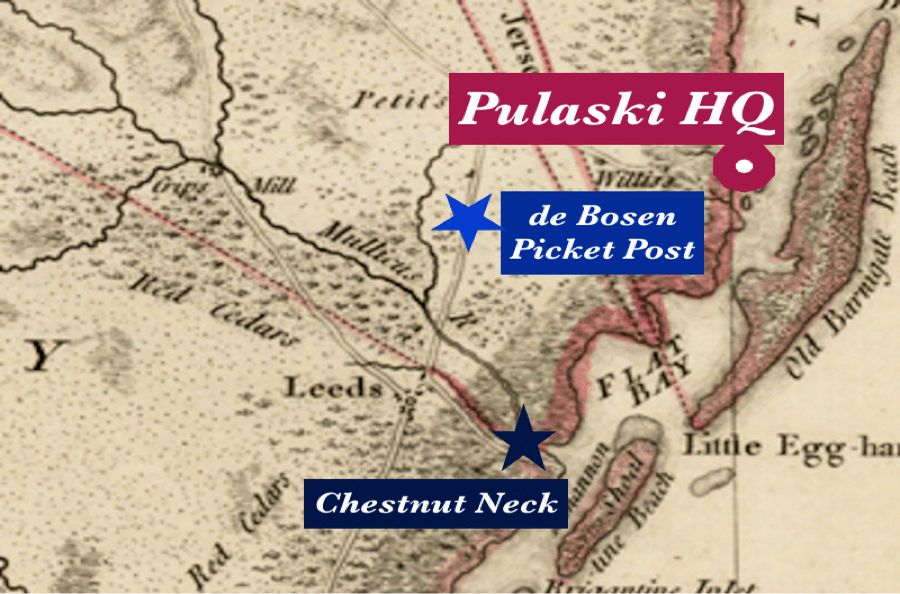
Unfortunately, it is very difficult to identify when the exciting action that Samuel described above might have taken place. Is Samuel Denike referring to the Little Egg Harbor massacre of Oct. 15, 1778—a week after the Battle of Chestnut Neck—when Pulaski’s forces were ambushed in a night raid? If so, who are the Colonels Taylor and Steele who Samuel Denike attests commanded American troops there?
There are a number of officers named “Steel,” as well as Steele, who fought in the Revolution. But I cannot place them at any battle on the New Jersey shore. On the other hand, a number of Revolutionary War soldiers with the last name of Steelman lived in the Egg Harbor area. And a Capt. Andrew Steelman did die in a similar ambush at Long Beach; but that happened four years later, on Oct. 25, 1782.
Late in 1778, Davis Denike was captured and sent to the infamous prison ship, the Jersey, a hulk that was anchored in Walkabout Bay, off the coast of Long Island, N.Y. Henry Davis testified that he was imprisoned on the Jersey at the same time as Denike.
The testimony that Davis Denike gave at his pension hearing states that he remained confined on the prison ship for at least seven months: “His health was much impaired by having been aboard the prison ship such a length of time, and he had the scurvy when he was exchanged.”
It took about nine more months for Denike to regain his health, but when he had fairly recovered, he rejoined the militia in a company commanded by Richard Higbee (1753-1825), who had been a 2nd lieutenant in Richard Payne’s company two years earlier and fought with them at Trenton on Christmas Day 1776 and at Princeton. As before, the company was assigned to patrol the seashore in order to protect people’s farms and houses from being plundered by British soldiers or by Tory militia and refugees who had moved into the area. Denike remained in Higbee’s company for close to two years.
He and others from the district then raised a new company of 20 men, which joined together with the company commanded by John Davis. Denike remained in the militia for another five months.
As his next assignment, probably in 1781, Davis Denike was placed in command of an armed galley, which carried a four-pounder cannon along with six swivel guns and two blunderbusses. Some 40 to 50 armed men served on the boat, which was pulled by 24 oars. Their job was to protect the seacoast from being plundered by the British and their Loyalist allies. Davis Denike’s younger brother, Samuel, served under him on the boat, and Henry Davis also joined one cruise. This assignment continued for about 20 months, until peace was declared.
A sea captain in Philadelphia
In the years after the war, Denike moved to Philadelphia. At one point, his sister also lived in the city or its close suburbs. On Sept. 1, 1789, he married Elizabeth Sutter—sometimes spelled “Suter”—at Gloria Dei. His wife appears to have been the Elizabeth Sutter who was born to John and Mary Sutter on Jan. 18, 1763 and baptized at Christ Church (or perhaps St. Peter’s Church) on July 21, 1764. The Denike’s first child, Catherine, was born in 1790.
During the 1790s, the Denike family lived in a number of different homes that they rented close to the waterfront in the Northern Liberties, a suburb of Philadelphia. In that period, Mary Sutter, a widow, lived close by and ran a small grocery store. At one point, in about 1796, the Denikes lived on Artillery Lane (now buried by the I-95 expressway), close to the creek called Pegg’s Run (now a sewer). A couple of years later, they moved a block away to Green Street. These houses were in the section of the Northern Liberties popularly called Camptown, since it once was the site of a British military camp.
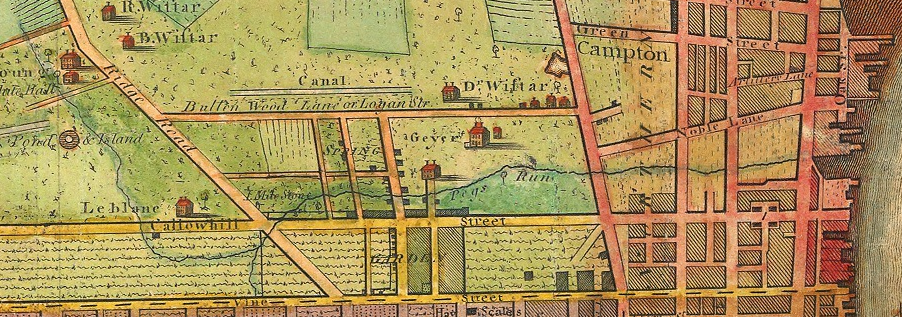
Beginning in about 1791, and for the next 30 years, Davis Denike worked as a sea captain, generally carrying passengers and cargo from Philadelphia to the Potomac ports of Alexandria and Georgetown, and occasionally stopping at Norfolk, St. Petersburg, and Richmond, Va. Once in a while, Denike was commissioned to take his sloops and schooners northward to New York City. The regular schedule of sailings allowed him to spend much more time at home compared to ship captains who took longer voyages abroad. It might be imagined that his experience as a pilot along the New Jersey coast made him very attentive to the shifting shoals and small islands that dotted the Delaware River—which could be extremely treacherous.
Three other men—Thomas, Robert, and Samuel Denike—were also sea captains in the trade between Philadelphia, Virginia, and occasionally other coastal ports during the 1790s. Samuel, of course, was Davis’s brother. It is still unclear, however, whether Thomas and Robert were also brothers (which is not unlikely), or whether they were more distant relatives. At times, the four Denikes exchanged vessels. For example, in the spring of 1796, Robert Denike captained the sloop Dolphin; then, in June 1796, Samuel Denike took the Dolphin for a voyage or two; and at the end of 1796, Davis Denike became the Dolphin’s master.
In this period, Thomas Denike had two mishaps at sea in which his vessel was wrecked. In one incident, in December 1795, Denike was master of the sloop William, bound from Richmond, Va., to New York. At one point, off Sandy Hook, N.J., the sloop foundered. A Capt. Grice of the ship Farmer found the sloop drifting with her rigging torn to pieces, and the passengers and crew short of provisions and water. He took up the survivors—11 in number—and carried them to Philadelphia (see The Philadelphia Gazette, Dec. 17, 1795).
Then, in October 1797, Thomas Denike’s sloop Hannah sprung a leak while encountering heavy gale winds off Cape May. The vessel was returning to Philadelphia from a voyage to Richmond, Va., and was laden with coal. Denike ordered the crew to drop anchor and bale out the rising flood, but at 4 in the afternoon on Oct. 4, it became apparent that they could not keep the Hannah above water. Denike and his three-man crew took to a lifeboat and drifted for 18 hours, until the schooner Polly, also returning from Alexandria, spotted them the following evening and brought them to Philadelphia (see Claypoole’s American Daily Advertiser, Oct. 10, 1797).
These two shipwrecks might have been portents of a far worse disaster that Thomas Denike would encounter three decades later, which we will describe below.
Beginning in February 1796, Davis Denike served as master of the sloop Sally in the coastal trade. In March 1800, he sailed the Sally to New York City. For the return voyage to Philadelphia, the sloop was authorized to carry as passengers 25 seamen who had been recruited to help man the U.S. frigate Philadelphia. The warship had been launched little more than three months earlier at Joshua Humphreys’ shipyard, just to the south of Gloria Dei Church in the Southwark suburb of Philadelphia.
On April 5, 1800, soon after Denike and the Sally arrived back in Philadelphia with the crew members, the frigate Philadelphia was officially commissioned. The Denike family might well have been part of the crowd who observed the ceremonies as Stephen Decatur Sr. was appointed as her first commander. The frigate sailed down the Delaware River from Fort Mifflin on April 13, but ran aground on a sand bar about a mile below the fort. After being freed, the frigate put to sea for duty in the West Indies, and assigned to counter the seizures of American merchant vessels by French and British privateers.
Two months later, in June 1800, Davis Denike found that despite his steady work in the coastal trade, he was forced to declare bankruptcy. He scheduled a hearing for later in the month with the Court of Common Pleas of Philadelphia County, in which he and his creditors could address the judges. Denike was claiming relief under the terms of the Insolvent Act, which had been passed two years earlier for the aid of insolvent debtors. It appears that through this means, he was able to make an arrangement with his creditors and to avoid debtors’ prison.
For the next two years, Davis Denike continued as the master of the sloop Sally, generally on short voyages to Alexandria and Georgetown, which had now been incorporated into Washington, D.C.—the federal capital.
In 1803, the Denike family moved slightly south of the city limits to the Passyunk Road. In 1804, and for some years afterward, they were listed at 214 Cedar St (also called South St.).
On Dec. 13, 1807, Robert E. Denike was born to Davis and Elizabeth. In later life, Robert became a mariner, like his father. On April 19, 1808, Catherine Denike, then 18 years old, married a slightly older man, Jacob Jackson (born in Sweden on Oct. 14, 1779). Jackson appears to have emigrated to this country a few years before his marriage and worked as a mariner (see: https://philahistory.org/2018/07/17/jacob-jackson-a-navy-man-in-the-war-of-1812/).
On Aug. 10, 1810, Davis Denike sailed on the schooner Nancy to Havana, Cuba. The master of the vessel was Moses Hawkins, who, unlike Denike, had long experience in the Caribbean trade.
The seamen’s protection papers that Denike obtained in preparation for the voyage give a description of him: He was said to be 48 years old; born in Gloucester County, N.J.; 5 feet, 10 inches tall; with a dark complexion, blue eyes, and dark hair that was turning gray. The scar on his left hand, obtained in the boarding of the Venus in 1778, was still visible. Davis’s brother Samuel accompanied him to the hearing with a notary as a witness.
Perhaps Denike sought to carry papers showing American citizenship because he was planning to take part in a voyage that would go beyond U.S. territorial waters. If he had sailed without documents proving that he was born in what was now the United States, he would have left himself open to being kidnapped by British warships and pressed into service in the Royal Navy.
Also in 1810, the Denike’s son Samuel (also a future mariner) was born; Elizabeth was 46 years old when her last child came into the world. And on Dec. 15 of that year, their daughter Catherine Jackson gave birth to her own daughter, Elizabeth, named for her grandmother. The baby was baptized four months later at Gloria Dei. The Jacksons’ first son, Jacob Jr., was born on Oct. 2, 1812, and baptized six months later at the same church—and seven other children were born to them in later years. During the War of 1812, Jacob Jackson Sr. enlisted in the U.S. Navy, serving first on the sloop Scorpion and later as a boatswain on the frigate USS Adams from Nov. 8, 1813 to Dec. 13, 1814. We can imagine that Elizabeth and Davis Denike did their best to help their daughter with her two small children while Jacob was at sea, even though they had their own children to care for—including their toddler, Samuel.
The last two decades
In those years, Davis Denike does not appear in newspaper notices of sea voyages. In the summer of 1816, however, he is listed in ads as the master of the sloop Harriot (called the Harriet in some ads,), bound to Norfolk and Richmond. In 1819 and for the next three years, shipping notices show him as captain of the Ann Eliza, voyaging to those same ports as well as to Alexandria and Petersburg, Va. On these voyages, he carried a mixed cargo of wine, gin, whiskey, books, steamboat machinery, dry goods, and much more—in addition to passengers—down to Virginia, while hauling sugar and other products back to Philadelphia.
Very curiously, in July 1821, when Davis Denike was captain of the Ann Eliza (reported to have put into Baltimore on June 30 on the way to Petersburg and arriving back in Philadelphia on Aug. 7), he was simultaneously listed in the Philadelphia Customs House ledgers as having enlisted to work on the sloop Eliza under a Capt. W. [William?] McAndrew, and bound to St. John, New Brunswick, Canada. The description of Denike is accurate in regard to age, height, hair color (“dark and grey”), and having been born in Gloucester County, N.J. Moreover, on the vessel’s return to Philadelphia on Aug. 19, the listing of crew members was signed by John Douglass Jr., of the Customs House staff, who knew Denike personally; they were both parishioners at Gloria Dei Church, and Douglass vouched for Denike some years later when he applied for his Revolutionary War pension.
My research strongly suggests that the name “Capt. W. McAndrew” was an error; I could not identify anybody of that name who commanded vessels in the port of Philadelphia in 1821 or any other year. However, the marine register published in newspapers from 1821 does show that a sloop Eliza was commanded by a Capt. McWilliams, voyaging from Philadelphia to St. John, N.B.
Thus, it seems apparent that the name “McAndrew” was mistakenly substituted for “McWilliams” in the Customs House ledger; John Douglass Jr. somehow overlooked the mistake when he approved the entry. But the mystery remains as to why Davis Denike was put on the Eliza’s crew sheet as a 59-year-old ordinary seaman when he was simultaneously sailing on the Ann Eliza as the master of the sloop. Did the Customs House confuse Capt. McWilliam’s sloop Eliza with Denike’s Ann Eliza?
Davis Denike continued his command of the Ann Eliza until the spring of 1822, but then seems to disappear from the maritime record. It is not unlikely that Denike, now in his 60s, left the sea-going life and joined the ranks of Philadelphia’s retired sea captains.
Philadelphia was still a major seaport but had lost its preeminence as a port to New York City, while Baltimore and Boston also competed for seaborne trade. However, Philadelphia was still thriving as a business hub, and its population continued to grow. Many sea captains who were Denike’s contemporaries went on to establish businesses such as chandlers, rope makers, merchants, and maritime insurance brokers. His son-in-law, Jacob Jackson, retired from the sea and became a stevedore during this period. However, there is no record of Denike being associated with any businesses. And while some retired sea captains could afford large townhouses as residences, and even employ servants, the Denike family appears to have continued to rent relatively small houses. Their finances might not have rebounded very far after Denike had been forced to declare bankruptcy over 20 years earlier.
Around that time, Davis Denike and his family were living at 35 Prime Street (now Washington Avenue), on the northern boundary of the U.S. Navy Yard. (The government had acquired the land, which used to be Joshua Humphrey’s shipyard, in 1800.) In 1823, however, Davis Denike and his family moved a few blocks away to the rear of 109 Christian Street.
On May 16, 1829, Davis Denike accompanied his 19-year-old son Samuel to a notary to receive Seaman’s Protection papers. The young man was described as being five feet, nine 1/2 inches in height, with a dark complexion, dark brown hair, with hazel eyes. A week later, Samuel shipped out on the brig Good Hope, of Boston, on a voyage to Havana, Cuba. The captain was Allen C. Ainsworth. Also on the brig was Samuel’s nephew and close friend, 17-year-old Jacob Jackson Jr.—described as five feet, seven inches in height, with a dark complexion and brown hair.***
Young Samuel was still en route to Cuba on June 1, 1829, when his mother, Elizabeth Denike, passed away. She was 66 years old and three months short of celebrating her 40th anniversary of marriage to Davis Denike. On July 5, Samuel’s vessel, the Good Hope, left Havana for Antwerp, and then on to Liverpool and back to Havana. It’s doubtful that he knew that his mother had died until he returned to Philadelphia many months later.
As we reported above, the brothers Davis and [the elder] Samuel Denike applied for Revolutionary War service pensions in 1832. Subsequently, both men were granted cash allowances for their service. The money was given only for the time they spent in the New Jersey militia, and not for their shipboard work as privateers. Nevertheless, in the Pension Act of 1832, Congress granted full pay to all veterans who had served at least two years in the revolutionary forces, including in state militias.
Samuel, for example, received $36.66 a month from the government, paid every March and September for the previous three months. In other words, the brothers each received about $220 a year, which would be the equivalent of about $8000 today. That was close to the equivalent of the earnings of many poor agricultural workers, who only received about 50 cents a day in wages, but less than the wages of better paid workers in the city. It’s possible, of course, that the service pension was not too meager for Davis Denike, a widower in his last years and with adult children to help him out now and then.
Meanwhile, going into the 1830s, Thomas Denike continued into his fifth decade of sailing on regularly scheduled routes from Philadelphia to Virginia, and sometimes to Baltimore and to New York City. In 1836, Denike was commanding the sloop Capital, which was returning home to Philadelphia after leaving Norfolk, Va., on Jan. 2. It appears that the Capitol had attempted twice to enter Delaware Bay but a squall drove her back far to the south, to where a chain of sand bars and small islands lie off the Delmarva Peninsula. The Pennsylvanian newspaper (Jan. 20, 1836) reprinted a letter by John Adams, the local Commander of Wrecks, on the catastrophe. He explained, “The wind blowing strong from the N.W. split mainsail and let go both anchors—lay there about an hour, slipped the cables and put back—at 10 o’clock on Friday night, the vessel struck on Machapungo [i.e., Machipongo] Bar, and immediately bilged—she however thumped over, and came up near the surf; a part of the bottom got on shore before the crew.
“On Saturday, 3 o’clock PM, the Islanders assisted in passing a line, by which means the crew were all saved, except Capt. Denike, who was drowned. He was decently interred on the Island.”
On the evening of Feb. 14, 1838, Davis Denike died. A Sunday afternoon funeral was held at the house of his daughter and son-in-law, Catherine and Jacob Jackson, at 23 Christian St. Then the coffin was conducted to the nearby Gloria Dei churchyard, where it was lowered into the plot in which Elizabeth Denike had been laid to rest 17 years earlier.
The Philadelphia newspapers printed a short notice of Davis Denike’s passing. The Public Ledger headlined its item, “Another Revolutioner gone!”
NOTES:
- The Mullica River, formerly known as the Little Egg Harbor River, is named for Eric Mullica, the Swede who has been credited as being the first European settler in the region.
** Capt. Thomas Palmer commanded privateers along the New Jersey seacoast and the Delaware River. However, Palmer was captured on June 12, 1778, and imprisoned on a British prison ship until March 1779. Therefore, Denike could not have served under Thomas Palmer in the fall of 1778.
*** In 1831, Samuel Denike and Jacob Jackson Jr. again shipped out together, joining the crew of the ship Tuscarora (James M. Verrill, captain) on a voyage to Liverpool, England. They remained good friends and shipmates for many years. In 1865, Jacob Jackson Jr. died on the sloop Emily, captained by Samuel Denike, when a storm swamped their vessel in the Potomac River (see:
**** On Nov. 14, 1843, the elder Samuel Denike, Davis’s brother, passed away in New Jersey. He had retired from the sea and had been living for many years close to the Mullica River, not far from their childhood home.

